People safety · Manual handling
The Stubborn Load
When it won’t roll, stop and find out why.
The video didn’t load. Please refresh the page and try again.
Read the guide: The Hazardous Manual Tasks Code explained →
Suits: Warehouse and logistics · Manufacturing · Transport
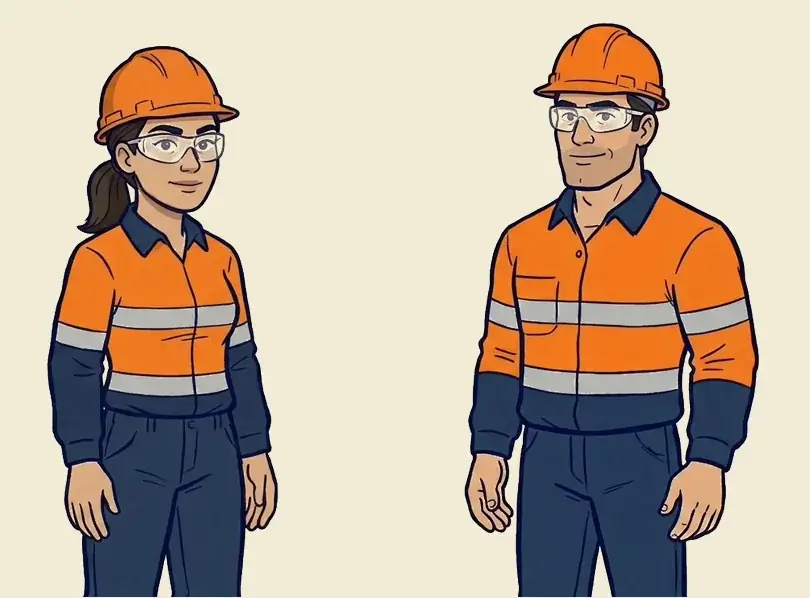
Meet the warehouse crew in this episode →


What happens in this episode
Lee is moving a loaded pallet jack across the warehouse. It stops dead. Instead of checking why, he leans in and shoves the handle hard.
The video freezes and asks: how should this be done safely?
Then we see the SafeLee way: he stops, eases the jack back, and finds a broken board on the floor in front of the wheels. He picks it up off the open floor, bins it, and moves the load with a steady push from behind the handle. Nobody reaches under the load.
Why it matters
- Body stressing, including pushing and pulling, is the most common cause of serious workers’ compensation claims in Australia: 51,800 claims, or 35.2%, in Safe Work Australia’s latest national figures.
- Those claims cost a median of 9.5 weeks off work and $21,200 in compensation each.
- A sudden jerk or shove is one of the quickest ways to hurt a back or shoulder. Needing unusual force is a sign that something’s wrong with the floor, the wheels or the load.
Source: Safe Work Australia, Key Work Health and Safety Statistics Australia 2026.
Key points
- If it won’t move, stop. Don’t jerk it or shove harder.
- Check the floor, the wheels and the load, and clear the cause.
- Faulty jack? Tag it out and report it.
In your version
- Your business’s logo on the opening card and throughout, instead of “Your Business Here”.
- A short quiz after the video. Workers need every answer right for it to count, with as many tries as they need.
- A one-page safe work guide to download, with links to your state’s regulator.
- A record of who watched, when, and how they went, in SafeLee’s built-in training records or your own LMS.
Use it at a toolbox talk
- Play the video (under two minutes).
- At the freeze, ask the crew what should happen, before the video shows them.
- Ask: “When did a trolley or jack last fight back here? What was the cause?” Agree one fix: a floor repair, a wheel check, or a tag-out process.
More ideas: toolbox talk topics.
Related guides
- Hazardous manual tasks code of practice
- Manual handling training
- Safety training videos
Check the rules where you work
Safety laws are similar across Australia, but each state and territory has its own regulator, and Victoria has its own Act. Choose where you work for your regulator’s guidance.
WorkSafe Queensland Queensland
Work Health and Safety Act 2011 (Qld)
SafeWork NSW New South Wales
Work Health and Safety Act 2011 (NSW)
WorkSafe Victoria Victoria
Occupational Health and Safety Act 2004 (Vic): a different law with similar duties. Victoria uses compliance codes rather than the model codes of practice.
SafeWork SA South Australia
Work Health and Safety Act 2012 (SA)
WorkSafe WA Western Australia
Work Health and Safety Act 2020 (WA)
WorkSafe Tasmania Tasmania
Work Health and Safety Act 2012 (Tas)
WorkSafe ACT Australian Capital Territory
Work Health and Safety Act 2011 (ACT)
NT WorkSafe Northern Territory
Work Health and Safety (National Uniform Legislation) Act 2011 (NT)
Comcare Commonwealth
Work Health and Safety Act 2011 (Cth)
Model WHS laws and model codes of practice. A national policy body, not a regulator.
General information only, not legal advice. Safety laws differ between states and territories and change over time. Check the law that applies where you work, follow your site procedures, and talk to your regulator or a WHS professional about your workplace. SafeLee episodes and guides support, and don’t replace, workplace-specific training, supervision and risk assessment.
Sources
- Safe Work Australia, Key Work Health and Safety Statistics Australia 2026 (body stressing, p. 15)
- Safe Work Australia, Model Code of Practice: Hazardous manual tasks
- Safe Work Australia, Model Code of Practice: Managing the risks of plant in the workplace
Model Codes of Practice have legal effect only where adopted in your jurisdiction. Check with your regulator and follow your site procedures.
This video, with your logo.
Every SafeLee episode comes branded for your business, with a quiz, a safe work guide and training records.