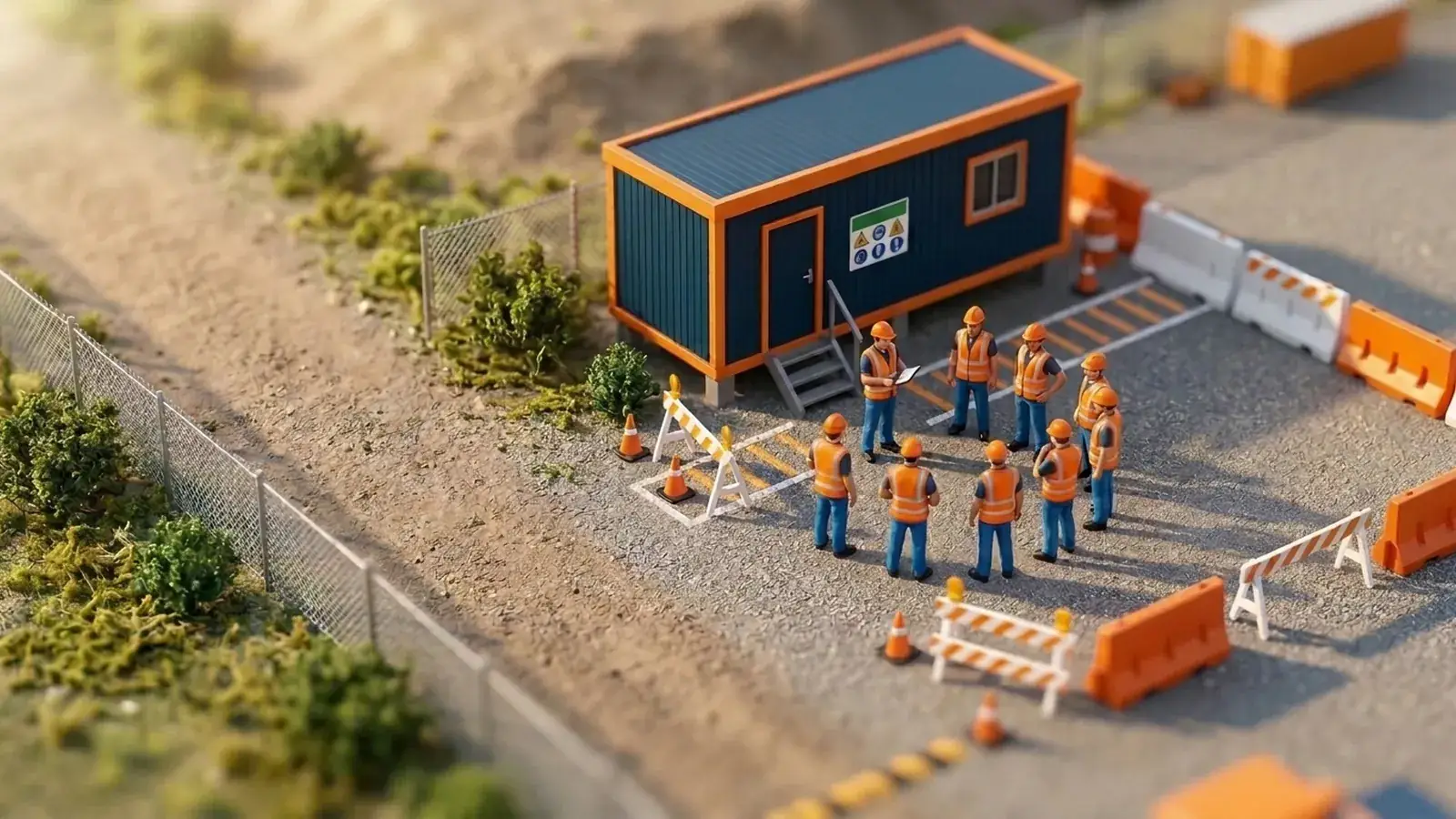
Short answer: A toolbox talk is a short, informal safety meeting, usually 5 to 15 minutes at the start of a shift, focused on one hazard or task. The best topics come from the work your crew is doing this week. Below are 30 ideas to get you started, grouped by hazard, plus a free template for recording each talk.
Watch: The Shortcut, about 90 seconds. See the episode →
The video didn’t load. Please refresh the page and try again.
Also: Wet Floor →
What a toolbox talk is (and isn’t)
A toolbox talk, also called a toolbox meeting, safety talk or tailgate talk, is a quick conversation with the crew about one safety topic. It’s often run as part of the pre-start meeting, before the day’s work begins.
A good toolbox talk is:
- Short. Ten minutes is plenty. One topic, not five.
- Relevant. About the work being done on this site, this week.
- Two-way. The crew talks as much as the presenter. Workers often know where the real risks are.
- Recorded. Who attended, what was covered, what was raised and what will be done about it.
A toolbox talk isn’t a substitute for proper training, a risk assessment or a safe work procedure. It’s a way to refresh key points, raise issues early and keep safety part of everyday conversation.
Why toolbox talks matter (and what the law expects)
Picture Jo, a leading hand at a timber yard in Geelong. Last week a new casual nearly backed a loaded trolley into the saw bench because he couldn’t see over the load. On Monday morning, Jo spends eight minutes with the crew: what happened, why it happened, and what everyone will do differently (“if the load blocks your view, split it or get a spotter”). One of the older blokes mentions the same thing happens at the loading door, so Jo writes that down too, and fixes it by Wednesday.
That’s a toolbox talk doing its job. The crew learned something, someone raised a problem the boss didn’t know about, and it got fixed.
What the law says, in plain English
No law says “you must hold toolbox talks”. But Australia’s WHS laws do expect businesses to give workers the information, training, instruction and supervision they need to work safely, in a way they can actually understand, and to talk with workers about safety and listen to what they say. A regular, recorded toolbox talk is one of the simplest ways to do both. Regulators recognise it too: SafeWork SA, for example, lists weekly toolbox meetings as one way to consult workers. Victoria has its own law with very similar expectations.
30 toolbox talk topics
Pick the topic that matches the work coming up. Each one has a question to put to the crew.
Manual handling
Body stressing is the most common cause of serious workers’ compensation claims in Australia: 35.2% of serious claims in the preliminary 2024–25 data (Safe Work Australia, Key Work Health and Safety Statistics Australia 2026).
- Plan the lift before you lift. “What would make you stop and change the plan before moving this load?”
- Loads near the floor. “Which items do we pick from floor level every day, and could they be raised?”
- Long reaches at the bench. “Where do you reach or twist more than you should on this bench?”
- Trolleys and visibility. “When does a loaded trolley block your view, and what do we do then?”
- High shelves. “What do we handle often that’s stored above shoulder height?”
- Equipment that fights back. “Which trolley, jack or tool needs extra force, and has it been reported?”
Slips, trips and falls
- Spills. “Who protects a spill until it’s cleaned up?”
- Walkways and leads. “Where do leads, hoses or packaging end up across walkways?”
- Ladders and quick reaches. “When do people grab a chair or crate instead of the right access equipment?”
- Loading dock edges. “How do we keep people back from an open dock edge?”
- Lighting and housekeeping. “Which areas are poorly lit or cluttered at the start or end of the day?”
Plant, vehicles and machinery
- Forklifts and pedestrians. “Where do people and forklifts share space, and how do we keep them apart?”
- Reversing vehicles. “Where should pedestrians wait while a truck reverses into the bay?”
- Isolation before clearing jams. “Who is allowed to clear a jam, and what has to happen first?”
- Missing or damaged guards. “What do we do if a guard is missing?”
- Crush zones. “Where could someone get caught between a moving load and a fixed object?”
- Pre-start checks on plant. “What do we check before using this machine, and what happens if it fails?”
Hazardous chemicals and electrical
- Unlabelled containers. “What do you do if you find a bottle with no label?”
- Safety data sheets. “Where are the SDSs for the chemicals we use, and who has read them?”
- Damaged leads and tools. “How do we take damaged electrical gear out of service?”
- Mixing chemicals. “Which cleaning products should never be mixed?”
Psychosocial hazards and fatigue
- Workload and deadlines. “When does the workload get unsafe, and who can change it?”
- Fatigue. “What are the signs someone is too tired for a safety-critical task?”
- Respectful behaviour. “Where’s the line between banter and bullying?”
- Aggressive customers or visitors. “When should you call for support or step away?”
- Speaking up. “If you see something unsafe, who do you tell, and what happens next?”
General
- Emergency procedures. “Where’s our assembly point, and who’s our first aider today?”
- PPE that fits. “Is anyone’s PPE damaged, uncomfortable or the wrong size?”
- Near-miss reporting. “What near misses have we had this month, and what did we change?”
- Heat and sun. “How are we managing heat and UV on hot days?”
How to run a toolbox talk that sticks
- Choose one topic linked to this week’s work, a recent incident or near miss, or something workers have raised.
- Show it, don’t just say it. A short video, a photo from site, or the actual equipment beats reading from a sheet. Each SafeLee episode runs about a minute and a half, so it fits a pre-start.
- Ask, then listen. Use the question for the topic and give people time to answer.
- Agree on actions. If something needs fixing, write down what, who and by when.
- Record it (see below), and follow up at the next talk.
- Keep it short. If it runs past 15 minutes, split it into two talks.
Language and literacy: if some of your crew speak English as a second language, keep words simple, use visuals, and check understanding by asking people to explain the key point back. Information must be readily understandable to the people receiving it.
Recording toolbox talks
A short record helps show what information and instruction was given, who received it, and what was done about issues raised. Record:
- date, time, site and presenter
- the topic and key points
- issues and ideas raised by workers
- actions, with an owner and a due date
- attendance, with each person’s name and signature
Keep toolbox talk records with your other training records. If you use SafeLee, a supervisor can play an episode at the pre-start, tick who attended, and each worker confirms on their own phone, so the record is kept for you.
Free toolbox talk template
Download our free toolbox talk record template (Word). It covers topic and key points, questions for the crew, hazards raised, actions, attendance for 20 people and presenter sign-off.
Word document, free, no sign-up.
Common questions
How long should a toolbox talk be?
Usually 5 to 15 minutes. Long enough to cover one topic properly and hear from the crew; short enough to hold attention.
How often should we hold toolbox talks?
There’s no set frequency in the model WHS laws. Many workplaces run them weekly or at each pre-start, plus extra talks when work, equipment or conditions change, or after an incident.
Who should run a toolbox talk?
Usually a supervisor or team leader, but workers can run them too. Rotating presenters is a good way to build ownership.
Is a toolbox talk the same as training?
No. A toolbox talk refreshes and discusses key points. Workers still need training that’s suitable for their tasks and the risks involved.
Do we need to keep toolbox talk records?
The model WHS laws don’t specifically require toolbox talk records, but keeping them is good practice and helps show how you’re informing, instructing and consulting workers.
Sources
- Safe Work Australia, model WHS Act: s19 (primary duty of care, including information, training, instruction and supervision), s47 and s48 (consulting workers); model WHS Regulations r39 (information, training and instruction)
- Safe Work Australia, Work health and safety consultation, cooperation and coordination Code of Practice
- Safe Work Australia, Key Work Health and Safety Statistics Australia 2026 (body stressing: 51,800 serious claims, 35.2%; p. 15)
- SafeWork SA, consultation and representation (toolbox meetings as an agreed consultation arrangement)
- Occupational Health and Safety Act 2004 (Vic), s21 and s35