People safety · Slips, trips and falls
The Shortcut
Clear the walkway, don’t step over it.
The video didn’t load. Please refresh the page and try again.
Read the guide: Toolbox talk topics →
Suits: Warehouse and logistics · Manufacturing · Transport
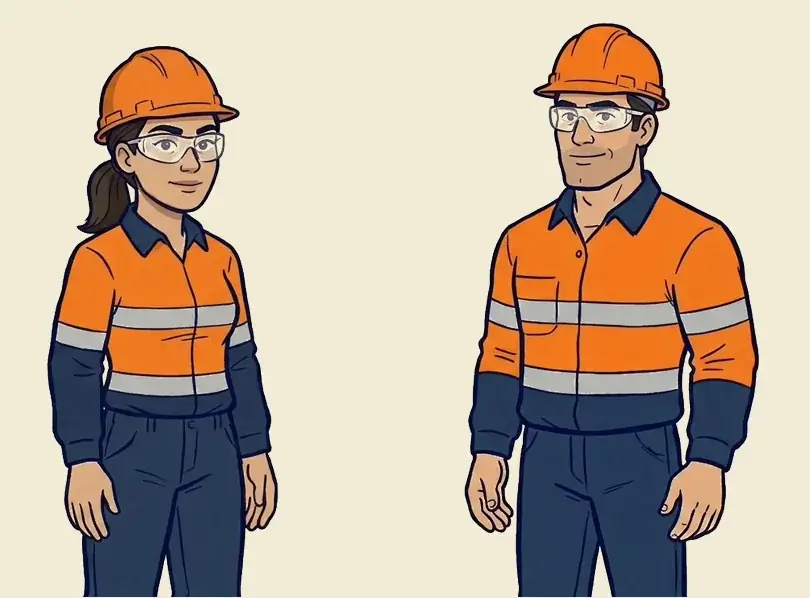
Meet the warehouse crew in this episode →


What happens in this episode
Lea carries a carton down the warehouse walkway, held high so it hides her feet. Loose shrink-wrap and an extension lead lie across her path. She steps over them, catches her toe and stumbles, then keeps going. Coming back with another carton, she’s about to do it again.
The video freezes and asks: how should this be done safely?
Then we see the SafeLee way: Lea puts the carton down clear of the walkway and bins the loose wrap. The lead is unplugged, re-run along the back of the bench so it no longer crosses the walkway, and plugged back in. She picks the carton up again, held low enough to see over, and walks a clear walkway.
Why it matters
- A serious slip, trip or fall claim typically means almost nine weeks off work, in Safe Work Australia’s latest national figures.
- A near miss is a warning. The lead and wrap are still there for the next person, who may not recover their footing.
- Carrying a load makes it worse: you can’t see your feet and can’t easily catch yourself.
Source: Safe Work Australia, Key Work Health and Safety Statistics Australia 2026.
Key points
- Don’t step over it. Put the load down and fix it at the source.
- Keep leads and packaging out of walkways.
- If you can’t fix it safely, block it off and report it.
In your version
- Your business’s logo on the opening card and throughout, instead of “Your Business Here”.
- A short quiz after the video. Workers need every answer right for it to count, with as many tries as they need.
- A one-page safe work guide to download, with links to your state’s regulator.
- A record of who watched, when, and how they went, in SafeLee’s built-in training records or your own LMS.
Use it at a toolbox talk
- Play the video (under two minutes).
- At the freeze, ask the crew what should happen, before the video shows them.
- Ask: “Where do leads, wrap or packaging end up across our walkways?” Agree one fix, and who’ll do it.
More ideas: toolbox talk topics.
Related guides
- Near-miss reporting that people actually use
- Toolbox talk topics
- Safety induction checklist
- WHS training requirements
Check the rules where you work
Safety laws are similar across Australia, but each state and territory has its own regulator, and Victoria has its own Act. Choose where you work for your regulator’s guidance.
WorkSafe Queensland Queensland
Work Health and Safety Act 2011 (Qld)
SafeWork NSW New South Wales
Work Health and Safety Act 2011 (NSW)
WorkSafe Victoria Victoria
Occupational Health and Safety Act 2004 (Vic): a different law with similar duties. Victoria uses compliance codes rather than the model codes of practice.
SafeWork SA South Australia
Work Health and Safety Act 2012 (SA)
WorkSafe WA Western Australia
Work Health and Safety Act 2020 (WA)
WorkSafe Tasmania Tasmania
Work Health and Safety Act 2012 (Tas)
WorkSafe ACT Australian Capital Territory
Work Health and Safety Act 2011 (ACT)
NT WorkSafe Northern Territory
Work Health and Safety (National Uniform Legislation) Act 2011 (NT)
Comcare Commonwealth
Work Health and Safety Act 2011 (Cth)
Model WHS laws and model codes of practice. A national policy body, not a regulator.
General information only, not legal advice. Safety laws differ between states and territories and change over time. Check the law that applies where you work, follow your site procedures, and talk to your regulator or a WHS professional about your workplace. SafeLee episodes and guides support, and don’t replace, workplace-specific training, supervision and risk assessment.
Sources
- Safe Work Australia, Key Work Health and Safety Statistics Australia 2026 (median time lost, falls, trips and slips)
- Safe Work Australia, Model Code of Practice: Managing the work environment and facilities
- Safe Work Australia, Model Code of Practice: Managing electrical risks in the workplace
- Safe Work Australia, Guide: Managing the risks of slips, trips and falls
Model Codes of Practice have legal effect only where adopted in your jurisdiction. Check with your regulator and follow your site procedures.
This video, with your logo.
Every SafeLee episode comes branded for your business, with a quiz, a safe work guide and training records.