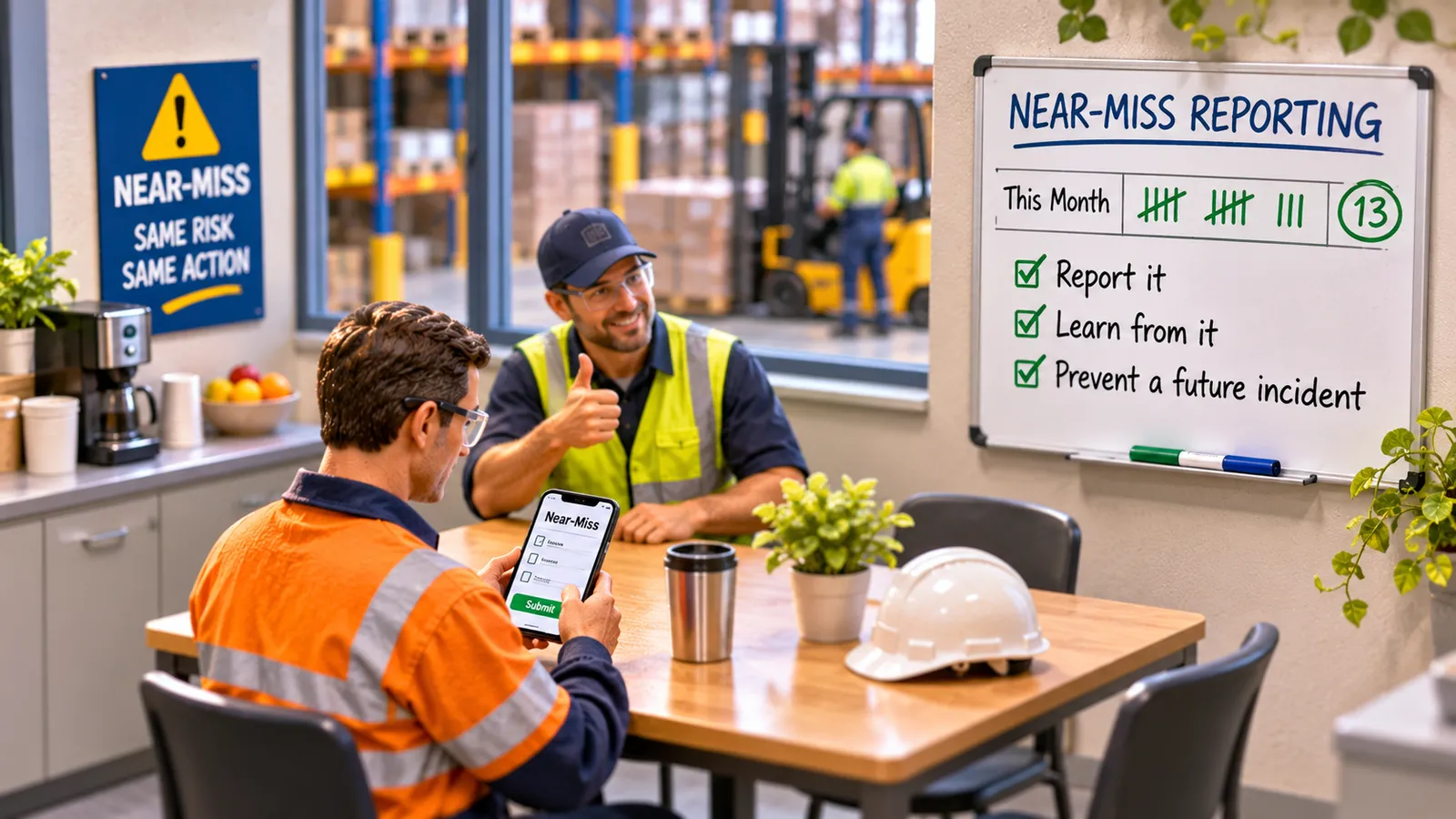
Short answer: A near miss is something that could have hurt someone but didn’t, this time. A carton that falls from a shelf and lands where someone was standing a second earlier. A forklift that brakes just in time. Near misses are free warnings: they show where the next injury is likely to come from. Reporting works when it’s quick, blame-free, and people can see that something gets fixed.
Watch: The Shortcut, about 90 seconds. See the episode →
The video didn’t load. Please refresh the page and try again.
Also: Falling Stock →
“Nobody got hurt, so…”
Jordan works in a hardware store’s warehouse in Penrith. On Tuesday a box slid off the top shelf and landed beside him. He laughed it off, pushed the rest of the stock back and carried on. On Thursday, the same shelf dropped a box on a casual’s shoulder.
Jordan didn’t report Tuesday’s near miss because nobody was hurt, he didn’t want to make a fuss, and he wasn’t sure who to tell. If he had, someone might have checked how stock was being put away on that shelf.
Why people don’t report
- “Nothing happened.” It doesn’t feel worth the paperwork.
- Fear of blame. If reporting gets you or a mate in trouble, people stop reporting.
- Too hard. A three-page form at the end of a shift won’t get filled in.
- Nothing changes. If reports disappear into a folder, people stop bothering.
What a good near-miss system looks like
- Quick. A short form on a phone, a QR code on the wall, or a word to the supervisor who writes it down. Under two minutes.
- Blame-free. The aim is to fix the cause, not find someone to blame. Say so, and mean it.
- Clear about what to report. Give examples from your site: things falling, slips that didn’t end in a fall, vehicles and people getting too close, equipment that failed.
- Visible action. Tell people what was done about their report. A “you said, we did” list on the board works well.
- Thanked. Thank people who report. It tells everyone this is what you want.
- Looked at together. Every month, look for patterns. Five near misses at the same corner is a design problem.
The four questions to ask about each near miss
- What happened?
- What could have happened?
- Why did it happen? (Keep asking “why” until you reach something you can fix.)
- What will we change, and who will do it by when?
Near miss or notifiable incident?
Some near misses are serious enough that the law calls them “dangerous incidents”, and the regulator has to be told straight away. Examples include an uncontrolled collapse of a structure, a fall of materials from height, an uncontrolled spill or escape of a substance, or contact with live electricity. Once people are safe, leave the site as it is until the regulator says otherwise. Helping an injured person, making the area safe and preventing further harm always come first. The exact definitions differ between states and territories, so if you’re not sure, call your regulator.
What the law says, in plain English
There’s no general rule that every near miss has to be written down. But a business has to manage risks, and that means finding hazards, and near misses are one of the best ways to find them. Certain serious incidents, including some near misses (“dangerous incidents”), must be reported to the regulator immediately and the scene preserved, except to help someone, make the area safe or prevent further harm. Victoria has its own law with similar reporting duties.
Toolbox talk: three questions for your crew
- What’s a near miss you’ve seen here in the last month?
- What stops people reporting near misses on our site?
- What’s one near miss we should fix this week?
Common questions
Do near misses have to be reported to the regulator?
Only if they meet the definition of a “dangerous incident” in the law where you work. The definitions differ between states and territories, so check with your regulator if you’re unsure. Others are for your own records and improvement.
Should near-miss reports be anonymous?
Anonymous reporting can help where trust is low. But the goal is a workplace where people are comfortable putting their name to a report.
How do we stop near-miss reporting becoming a blame game?
Focus every discussion on the setup, the process and the equipment. Ask “what made this possible?”, not “who did it?”.
Sources
- Safe Work Australia, Incident notification guidance
- Safe Work Australia, model WHS Act: Part 3 (incident notification), including s37 (dangerous incidents) and s39 (preserving incident sites)
- Safe Work Australia, Model Code of Practice: How to manage work health and safety risks
- WorkSafe Victoria, Occupational Health and Safety Act 2004, incident notification