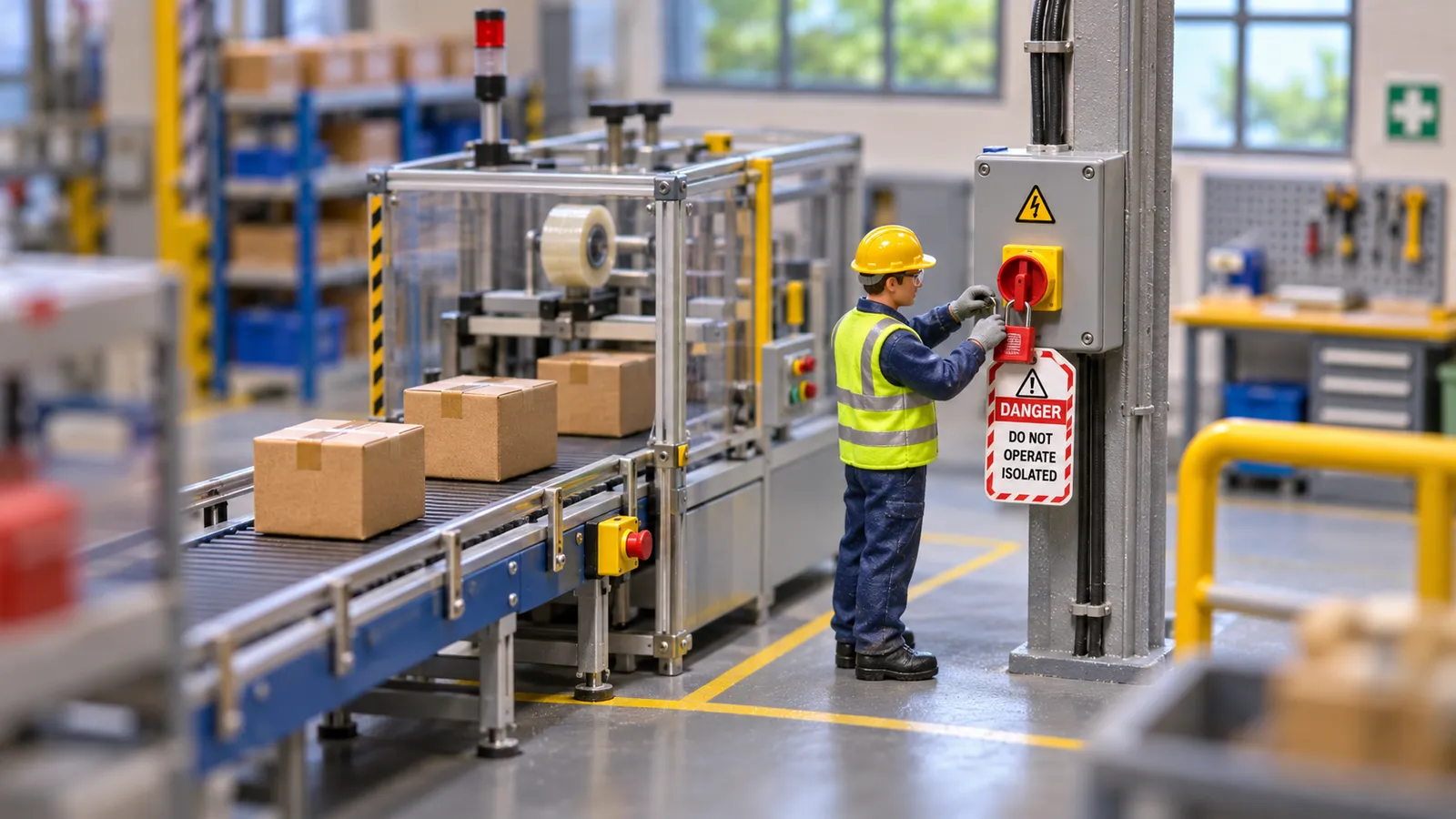
Short answer: A machine that has stopped is not the same as a machine that’s safe to reach into. Before anyone clears a jam, cleans or adjusts a machine, it should be switched off at the isolator, locked with that person’s own lock, tagged, and tested to prove it won’t start. It takes a minute or two, and it’s the step that keeps fingers and hands attached.
Watch: The Jam, about 90 seconds. See the episode →
The video didn’t load. Please refresh the page and try again.
Also: Missing Guard →
The jam that “only takes a second”
Deng runs the end of a packing line at a food manufacturer in Dandenong. A carton tips sideways and jams the conveyor. The belt stops. Deng has cleared this jam a hundred times. The quickest way is to reach in and flick the carton straight.
What Deng can’t see is that the belt has only stopped because the carton is holding it. The conveyor is still switched on. The moment the carton moves, the belt starts again, with Deng’s hand in the nip point.
That’s the trap with jams. They feel like a pause, not a hazard. And they happen dozens of times a shift, so reaching in becomes a habit.
Why it goes wrong
- “It’s stopped, so it’s safe.” Many machines stop on a sensor, a jam or a pause in the cycle. They restart on their own when the cause clears.
- Someone else presses start. On a long line, the person at the controls may not see the person at the other end.
- Stored energy. Springs, air pressure, hydraulics and gravity can move parts even when the power is off.
- Time pressure. Isolating feels slow when the line is backing up. That’s when shortcuts happen.
The safer way: isolate, lock, tag, test
This is the routine shown in The Jam. Most sites call it “isolation” or “lockout tagout”.
- Stop the machine using the normal stop button.
- Switch it off at the isolator. The isolator is the switch that cuts the power to that machine, not just the start and stop buttons.
- Fit your own lock. A personal lock means only you can switch it back on. If three people are working on the machine, there are three locks.
- Fit a danger tag. The tag says who is working on it and why. A tag tells people. Only a lock stops them.
- Release stored energy. Bleed air or hydraulic pressure, block parts that could fall, and let anything that spins come to a full stop.
- Test it. Try the start button. Nothing should move. If something does, stop and get help.
- Clear the jam. Then remove your lock and tag yourself, check everyone is clear, and restart.
Fixing the cause, not just the jam
If a jam happens every hour, the real fix is upstream. Ask the people on the line why it jams. It might be a worn guide rail, cartons out of spec, or a line running faster than it was set up for. Fewer jams means fewer chances for someone to reach in.
Where jams can’t be designed out, some machines can be fitted with a safe way to clear them without reaching into moving parts: an access door with an interlock, or a tool that does the reaching for you.
What the law says, in plain English
A business has to manage the risks of the plant it uses, as far as it reasonably can. Where people need to clear, clean or maintain a machine, there should be a way to do it with the machine isolated, so it can’t start while someone is working on it. Workers have to follow the isolation procedure and take reasonable care. Victoria has its own law with very similar expectations.
Toolbox talk: three questions for your crew
- Where do jams happen on our site, and how often?
- Where is the isolator for each of those machines, and does everyone know?
- Does everyone who clears jams have their own lock and danger tag?
Isolation check: the short version
- Every machine has a clearly labelled isolator
- Everyone who clears jams has a personal lock and danger tags
- Locks are personal: one person, one lock, one key
- Stored energy (air, hydraulics, springs, gravity) is covered in the procedure
- People test that the machine won’t start before reaching in
- Repeat jams are reported and fixed at the cause
Common questions
Is pressing the stop button enough?
No. A stop button stops the machine, but it doesn’t stop someone, or something, starting it again. The isolator plus a personal lock does.
Can we share one lock for the team?
Each person working on the machine should fit their own lock. That way the machine can’t restart until the last person has finished and removed theirs.
What if the jam is “just a quick flick”?
That’s exactly when most hand injuries happen. If reaching in is quicker than isolating, the job design needs fixing, not the rule.
Who can remove a lock?
The person who fitted it. Most sites have a strict procedure for the rare case where that person isn’t available.
Sources
- Safe Work Australia, Model Code of Practice: Managing the risks of plant in the workplace
- Safe Work Australia, model WHS Regulations, Part 5.1 (plant), including the regulation on isolating plant for maintenance and cleaning
- Safe Work Australia, model WHS Act: s19 (primary duty of care), s28 (duties of workers)
- WorkSafe Victoria, Occupational Health and Safety Act 2004