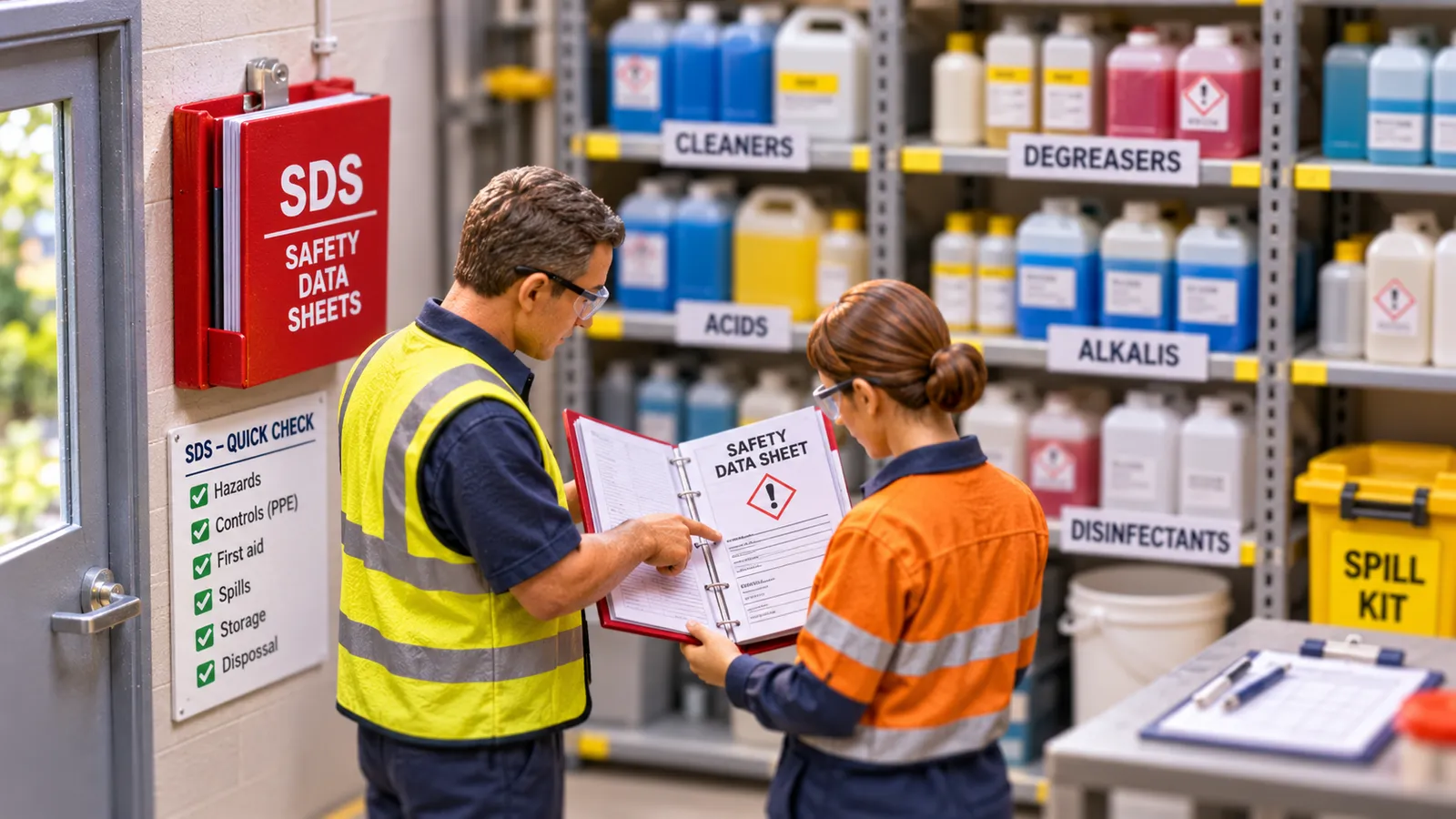
Short answer: A safety data sheet (SDS) is the instruction sheet for a hazardous chemical. It’s written by the manufacturer or importer and explains what the chemical is, how it can hurt you, how to use and store it safely, what protective gear to wear, and what to do if something goes wrong. A business that uses the chemical should have the current SDS on hand, keep it where workers can get to it, and make sure people know how to read the parts that matter.
Watch: The Mystery Bottle, about 90 seconds. See the episode →
The video didn’t load. Please refresh the page and try again.
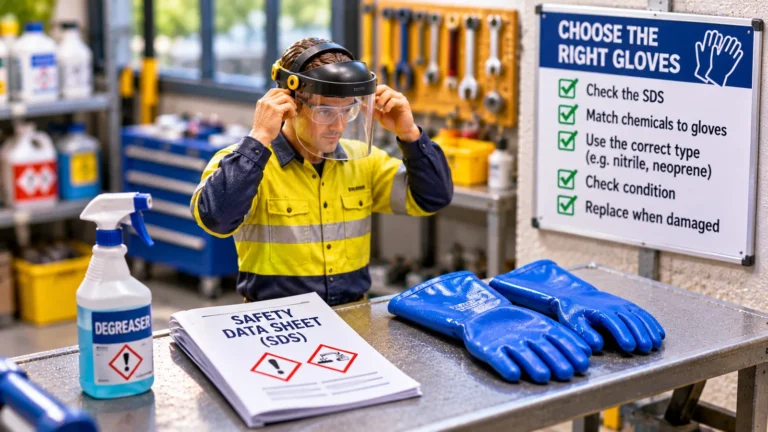
Also: Right Gloves for the Job →
The folder nobody opens
Mel manages a small commercial cleaning company in Geelong. When a new client asked to see her chemical records, she pulled out the SDS folder from the van. Half the sheets were for products she’d stopped using two years ago. Three of the products in the van had no sheet at all. And none of her cleaners had ever opened the folder.
Mel’s not unusual. SDSs often end up as paperwork for audits rather than information for the people using the chemicals. The fix is to make them current, reachable and understood.
The 16 sections, and the five that matter on the job
Every SDS follows the same 16-section layout. Workers don’t need to read them all. These five answer most day-to-day questions:
| Section | What it tells you | When you’d look |
|---|---|---|
| 2. Hazard identification | How the chemical can harm you, with hazard pictograms and warnings | Before using a product for the first time |
| 4. First aid measures | What to do if it gets on skin, in eyes, or is swallowed or breathed in | When something goes wrong |
| 7. Handling and storage | How to use and store it, and what to keep it away from | When setting up a store or a trolley |
| 8. Exposure controls / personal protection | Gloves, eye and face protection, ventilation | Before every new task |
| 10. Stability and reactivity | What it reacts with, such as acids or bleach | Before using it near another chemical |
The rest (transport, disposal, toxicology, regulatory information and so on) matters to the business and to emergency services, so the full SDS should always be available.
Where SDSs should live
- Close to where the chemical is used, not in an office drawer across the site.
- In a form people can reach quickly: a folder by the store, a laminated summary on the wall, or a QR code that opens the SDS on a phone. Whatever works, as long as it works when the power or Wi-Fi is down too.
- Current: check the date. SDSs are reviewed at least every five years, and sooner when something changes.
- Matched to the register: the list of hazardous chemicals on site should line up with the SDSs you hold.
Why it goes wrong on real sites
- Products change, the folder doesn’t. A new supplier or a new product arrives without its SDS.
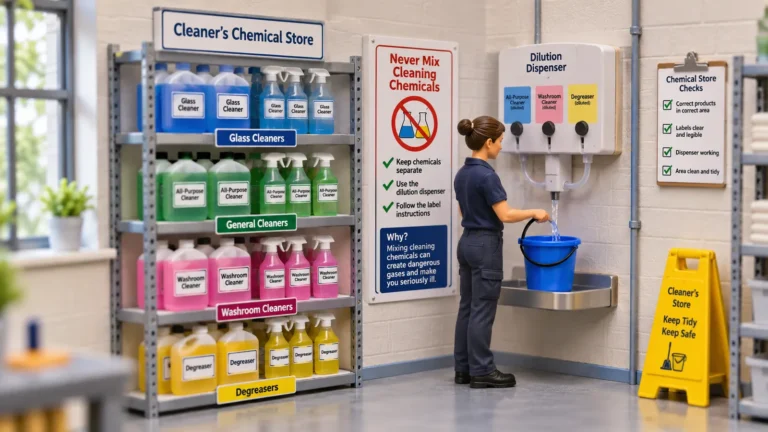
- Decanting. A chemical goes into a spray bottle, and the link to its SDS is lost. (See Label the Decant.)
- “Too technical.” Nobody shows workers which sections to read.
- Language. Workers who read English as a second language may need the key points explained another way.
The safer way, in five steps
- List every chemical on site, including the ones in vans and cleaners’ trolleys.
- Get the current SDS for each from the supplier or the manufacturer’s website.
- Put them where they’re used, and keep a master copy.
- Show people sections 2, 4, 7, 8 and 10. A ten-minute toolbox talk is enough to start.
- Check every six months, and whenever a new product comes in.
What the law says, in plain English
The manufacturer or importer of a hazardous chemical has to prepare its SDS. A business that uses the chemical has to get the current SDS, usually no later than when the chemical is first supplied, and make it readily available to workers and to emergency services. The business also has to keep a register of the hazardous chemicals on site. Victoria has its own law with very similar expectations.
Toolbox talk: three questions for your crew
- Where’s the SDS for the product you use most? Can you find it in under a minute?
- Which section tells you what gloves to wear?
- What would you do if you found a chemical with no SDS?
Common questions
What’s the difference between an SDS and an MSDS?
Nothing important. MSDS (material safety data sheet) is the old name. SDS is the current term.
Do we need an SDS for household cleaning products?
If a product is a hazardous chemical and it’s used at work, the business should hold its SDS. Many everyday cleaning products are hazardous chemicals. Check with the supplier.
Can SDSs be electronic only?
Yes, as long as workers and emergency services can get to them quickly when they need them.
How old can an SDS be?
Manufacturers and importers review them at least every five years. If yours is older, ask the supplier for the current version.
Sources
- Safe Work Australia, Model Code of Practice: Managing risks of hazardous chemicals in the workplace
- Safe Work Australia, Model Code of Practice: Preparation of safety data sheets for hazardous chemicals
- Safe Work Australia, model WHS Regulations, Chapter 7: preparing SDSs (manufacturers and importers), obtaining and keeping SDSs (businesses that use chemicals), hazardous chemicals register
- WorkSafe Victoria, Occupational Health and Safety Act 2004