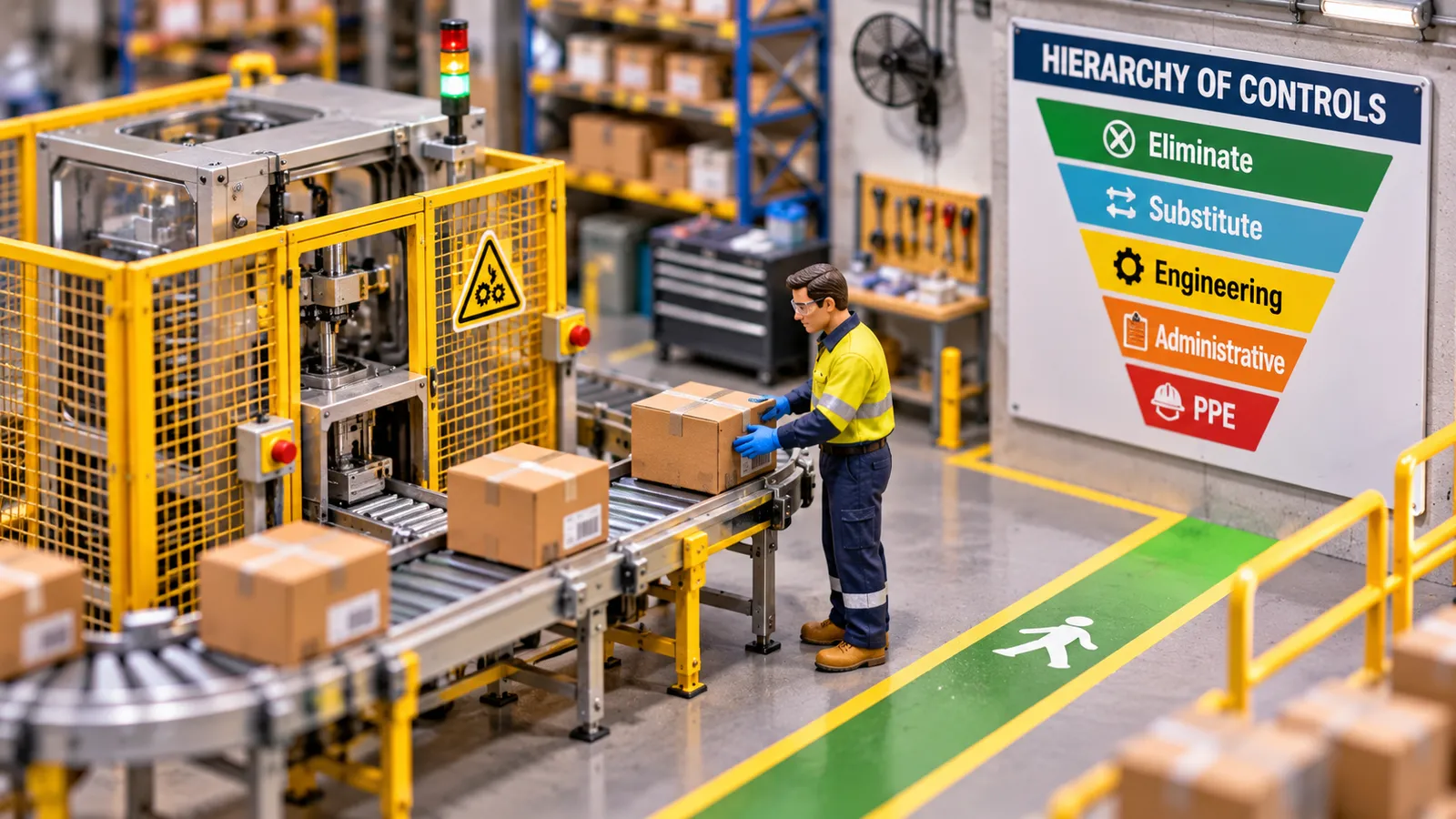
Short answer: The hierarchy of controls is a way of choosing the best fix for a hazard. You start with the most effective options, getting rid of the hazard or swapping it for something safer, and only move down the list when those aren’t reasonably practicable. Engineering fixes come next, then rules and training, and personal protective equipment (PPE) comes last. Most good solutions combine several levels.
Watch: Missing Guard, about 90 seconds. See the episode →
The video didn’t load. Please refresh the page and try again.
Also: Label the Decant, Dust You Cannot See, Seal and Check →
Two answers to the same problem
Two packing businesses in Adelaide have the same problem: workers lifting 20 kg cartons off the floor all day, and sore backs to show for it.
The first business runs a manual handling course every year and buys everyone a back belt.
The second business moves the cartons onto a pallet stand at waist height, and splits the order so cartons are 12 kg instead of 20. Then it trains people in the new setup.
Both businesses “did something”. Only one of them changed the work. That’s the idea behind the hierarchy of controls.
The levels, from most to least effective
| Level | What it means | Example |
|---|---|---|
| 1. Eliminate | Get rid of the hazard altogether | Buy pre-mixed product so nobody decants chemicals |
| 2. Substitute | Swap it for something less hazardous | Use a milder cleaning product that does the same job |
| 2. Isolate | Separate people from the hazard | Fence off the forklift area with barriers and gates |
| 2. Engineering | Change the plant, equipment or setup | Fit a guard to a machine; use a pallet stand or lifter |
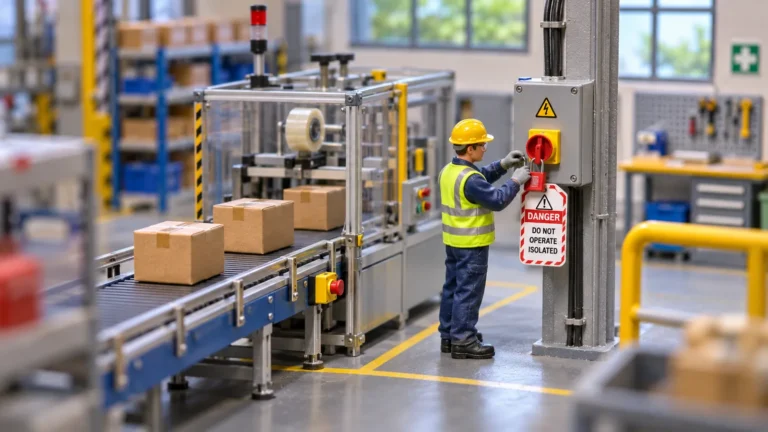
| 3. Administrative | Rules, procedures, signs, training | A lockout procedure; a toolbox talk; warning signs |
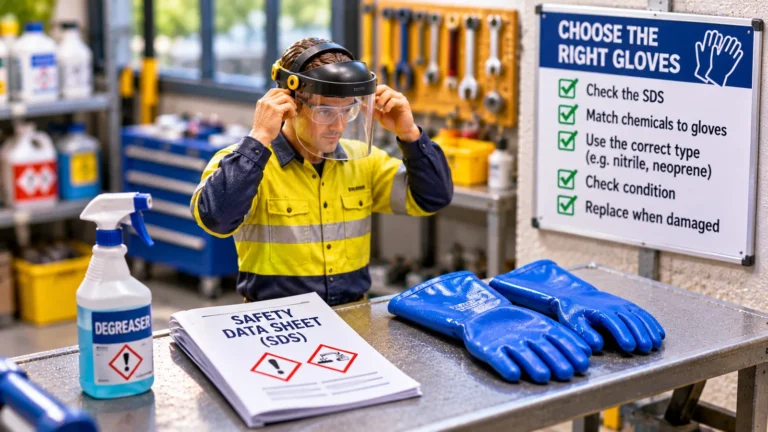
| 3. PPE | Gear people wear | Gloves, safety glasses, hearing protection |
In the model WHS Regulations, substitution, isolation and engineering sit together as the second level. Administrative controls and PPE are the last resort, used for whatever risk is left.
Why training and PPE come last
Training and PPE only work if a person remembers, is able to, and chooses to, every single time. On a busy shift, tired or rushed, that’s a lot to ask. A guard on a machine protects the worker on their worst day. A sign beside an unguarded machine doesn’t.
That’s not to say training doesn’t matter. It does: people need to know why the controls are there and how to use them. But training works best on top of a well-designed job, not instead of one.
How to use it
- Pick one hazard, such as lifting cartons from the floor.
- Start at the top. Can we remove it? Can we swap it for something safer? Write down why not, if not.
- Work down the list, adding controls until the risk is as low as you can reasonably get it.
- Combine levels. A pallet stand (engineering), a two-person rule for heavy items (administrative) and gloves (PPE) together beat any one alone.
- Ask the people doing the job. They’ll know what works and what will be ignored.
- Check it’s working. Watch the task a week later. Are people using the new setup?
Examples from SafeLee episodes
- Missing Guard: the guard is the engineering control; the “don’t run it unguarded, report it” rule is the administrative backup.
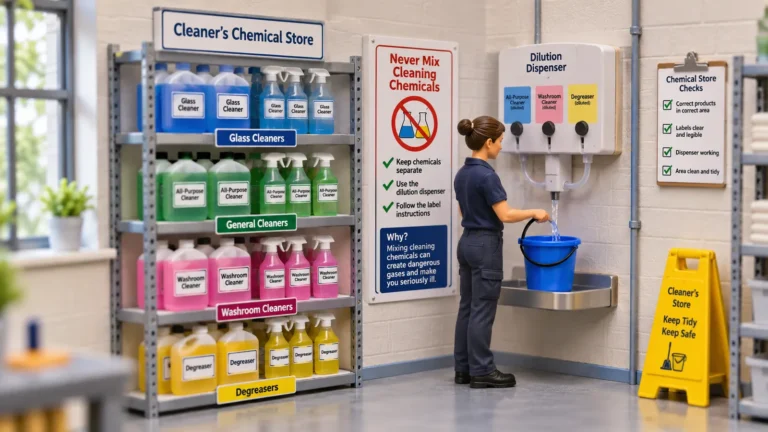
- Label the Decant: a pre-printed label for every product is an administrative control. It makes the right thing easy, but it still relies on people reading and following it.
- Bottom of the Pallet: lifting the load to a better height changes the task itself.
What the law says, in plain English
A business has to eliminate risks as far as it reasonably can. If it can’t, it has to reduce them, starting with substitution, isolation or engineering controls, then administrative controls, and finally PPE. It also has to keep the controls working and check them. Victoria has its own law with a similar approach.
Toolbox talk: three questions for your crew
- What’s one hazard on our site that we’re only managing with a sign or a rule?
- Could we remove it, or change the equipment instead?
- Which control here do people work around, and why?
Common questions
Is the hierarchy of controls a legal requirement?
In the jurisdictions that use the model WHS laws, the order of controls is set out in the WHS Regulations. In Victoria, the approach is similar under its own regulations.
Is PPE ever enough on its own?
Sometimes, for low risks where nothing higher up is reasonably practicable. But it should be a deliberate choice, not the first idea.
Who decides what’s “reasonably practicable”?
The business, weighing up the risk and what can be done about it. Cost only counts if it’s grossly out of proportion to the risk.
Sources
- Safe Work Australia, Model Code of Practice: How to manage work health and safety risks
- Safe Work Australia, model WHS Regulations, regulations 35 to 38 (managing risks, the hierarchy of control measures, maintaining and reviewing controls)
- Safe Work Australia, model WHS Act: s17 (management of risks), s18 (reasonably practicable)
- WorkSafe Victoria, Occupational Health and Safety Act 2004 and Occupational Health and Safety Regulations 2017