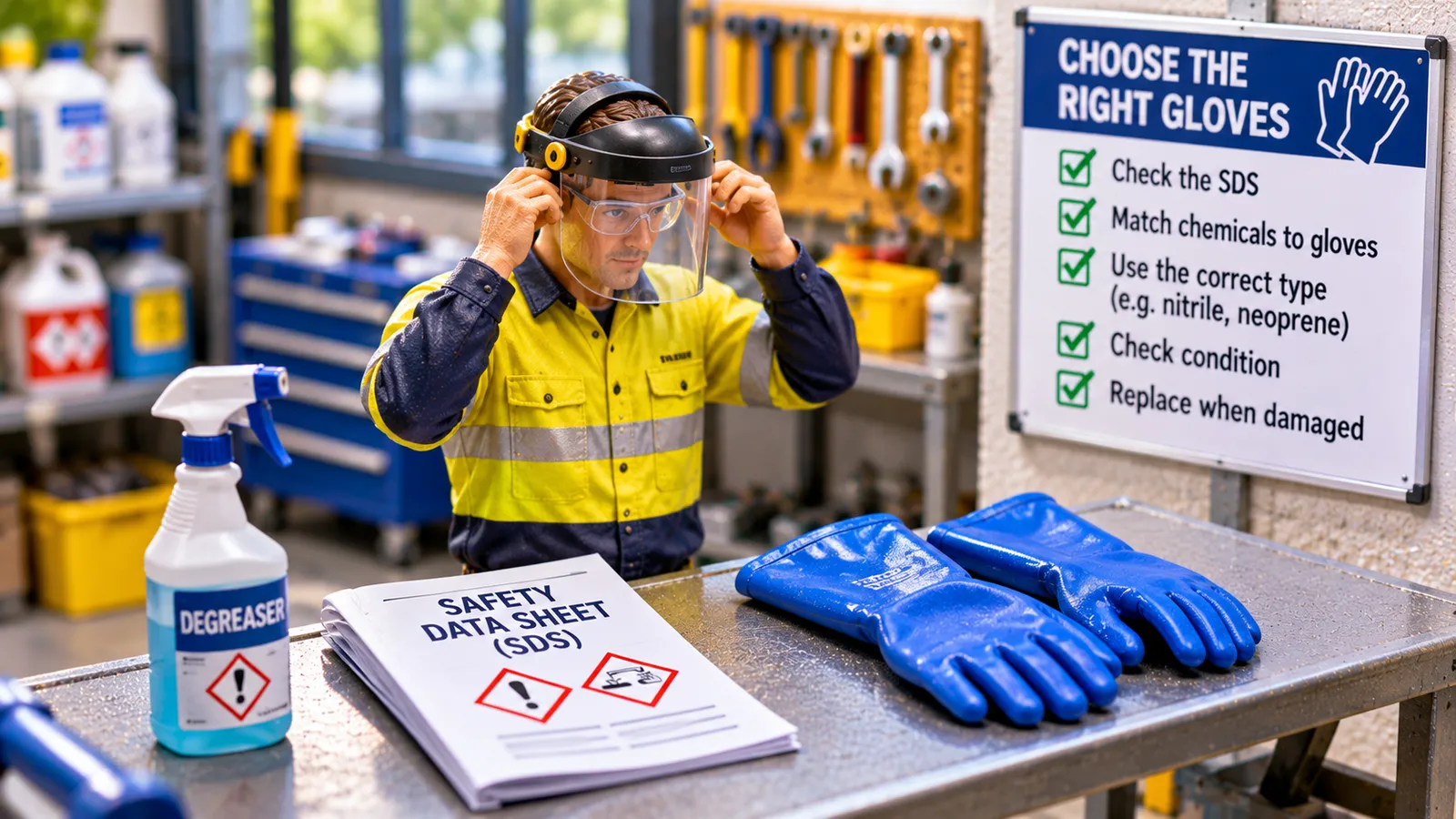
Short answer: Gloves are made to resist particular chemicals, so the wrong glove can let a chemical straight through to your skin. The product’s label and section 8 of its safety data sheet (SDS) say what protection it needs, including the type of glove and whether a face shield is required. Check them before you start, wear the gear for the whole job, and if the right gloves aren’t there, ask before you start.
Watch: Right Gloves for the Job, about 90 seconds. See the episode →
The video didn’t load. Please refresh the page and try again.
Also: Never Mix →
“It’s only a quick spray”
Kath maintains forklifts and conveyors in a distribution centre workshop in Brisbane. A gearbox cover is caked in grease. The degreaser is right there, and it’s a thirty-second job, so she grabs the bottle bare-handed.
Thirty seconds, several times a day, most days of the year. That’s how many skin problems start: not with one big splash, but with small, repeated contact that adds up.
What chemicals do to skin
Many everyday workplace chemicals, such as degreasers, solvents, drain cleaners and strong cleaning products, can:
- irritate or burn the skin, sometimes before you feel anything
- cause contact dermatitis: red, cracked, itchy skin that can become a long-term problem and, in some cases, end a career in a trade
- soak through the skin into the body.
Why the type of glove matters
There’s no such thing as an all-purpose chemical glove. Nitrile, neoprene, PVC, butyl and latex each resist some chemicals and not others. A glove that’s fine with one degreaser can break down quickly with a different solvent. Thin disposable gloves are often made for hygiene, not for chemicals.
Food gloves and chemical gloves are different gloves for different jobs. Food gloves protect the food, not your hands, and they’re covered in Gloves and handwashing in food businesses.
So “any gloves will do” isn’t true, and neither is “thicker is always better”. The right glove is the one the SDS names for that chemical.
Where to find out
- The label. Look for the precautionary statements, such as “Wear protective gloves/protective clothing/eye protection/face protection.”
- Section 8 of the SDS (“Exposure controls/personal protection”). It names the glove material and any eye or face protection.
- Your supervisor. If the SDS isn’t there or isn’t clear, ask before you start.
The safer way
This is the routine shown in Right Gloves for the Job.
- Check the label and the SDS first.
- Put on the gloves and face protection they call for. A face shield goes over your safety glasses, not instead of them.
- Check the gear: no holes, tears or worn patches in gloves; no cracks or scratches you can’t see through in the face shield.
- Keep it on for the whole job, however quick.
- Spray onto a rag rather than into the air, where you can.
- Take gloves off without touching the outside with bare skin, and wash your hands afterwards.
- No right gloves? Ask before you start. Don’t swap in whatever is nearby.
If a chemical gets on your skin
- Follow the first aid section of the SDS. This usually means washing with plenty of water straight away.
- Take off any splashed clothing.
- Tell your supervisor. For advice, call the Poisons Information Centre on 13 11 26. In an emergency, call 000.
- Report skin that becomes red, itchy, dry or sore after working with chemicals. It’s an early warning.
For supervisors: make the right choice the easy choice
- Stock the gloves the SDSs call for, in sizes that fit, where the chemicals are used.
- Label the glove bins by task or product (“degreaser: blue nitrile gauntlets”).
- Look at the chemical first: is there a less harmful product that does the job?
- Ask people about skin problems. Dermatitis is easy to miss and easy to dismiss.
What the law says, in plain English
Gloves and face shields are personal protective equipment (PPE). A business has to look at removing or reducing the chemical risk first, for example by using a less harmful product. Where PPE is still needed, the business has to provide the right gear, make sure it fits and is maintained, and train people in using it. Workers have to wear it as instructed and look after it. Victoria has its own law with very similar expectations.
Toolbox talk: three questions for your crew
- For the three chemicals we use most, which gloves does each SDS call for?
- Are those gloves on the shelf now, in everyone’s size?
- What do you do if the right gloves aren’t there?
Common questions
Are disposable nitrile gloves OK for chemicals?
Sometimes, for light splashes of some chemicals. Check the SDS: many chemicals need a heavier glove made for that chemical.
How long do chemical gloves last?
It depends on the glove and the chemical. Replace gloves that are torn, worn, stiff, swollen or discoloured, and follow the supplier’s guidance.
Do I need a face shield as well as safety glasses?
If the SDS says face protection, yes. The shield protects your face from splashes; your glasses protect your eyes underneath.
Sources
- Safe Work Australia, Model Code of Practice: Managing risks of hazardous chemicals in the workplace
- Safe Work Australia, Model Code of Practice: Labelling of workplace hazardous chemicals (precautionary statement P280)
- Safe Work Australia, model WHS Regulations, regulations 44 and 46 (personal protective equipment)
- Safe Work Australia, model WHS Act: s19 (primary duty of care), s28 (duties of workers)
- WorkSafe Victoria, Occupational Health and Safety Act 2004