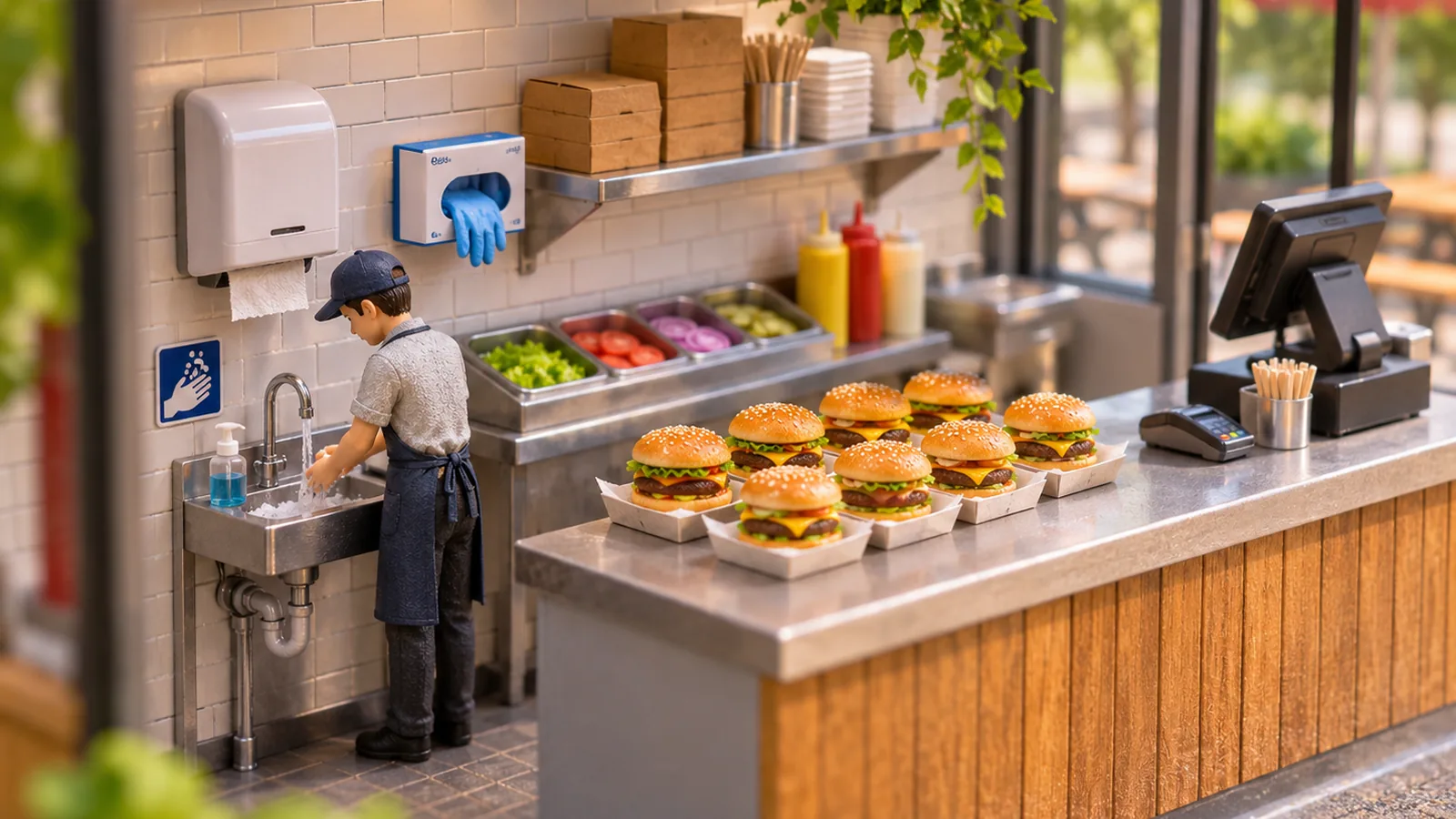
Short answer: Food gloves protect the food (and the customer), not your hands. Gloves pick up germs just like hands do, so once they touch something that isn’t clean, such as money, your phone, the bin or raw meat, take them off, wash and dry your hands at the hand basin, and put on a fresh pair. Gloves never replace handwashing.
Watch: Gloves Protect the Food, 84 seconds. See the episode →
The video didn’t load. Please refresh the page and try again.
“I’ve got gloves on, it’s fine”
Lunch rush at a burger shop. Lee is on the grill and the counter at once. He takes a customer’s cash, drops it in the till, then reaches straight for the bun with the same gloved hand.
The gloves look clean. They aren’t. Money passes through hundreds of hands, and whatever was on it is now on the burger. Wearing gloves made it feel safe, and that’s the trap.
Why it matters
Foodborne illness is common. FSANZ estimates around 4.7 million cases of food poisoning in Australia each year, with tens of thousands of people hospitalised. Hands, and gloves, are one of the easiest ways for germs to get onto food, especially ready-to-eat food that won’t be cooked again: burger buns, salads, sandwiches, pizza toppings after the oven, cut fruit.
Who the gloves are for
| Food gloves | Cleaning or chemical gloves | |
|---|---|---|
| Protect | The food and the customer | Your hands |
| Used for | Handling ready-to-eat food | Cleaning, sanitisers, chemicals |
| Reused? | Never. One task, then into the bin | As the product and supplier say |
Keep the two apart. Cleaning gloves never touch food, and food gloves aren’t for cleaning. Food gloves and chemical gloves are different gloves for different jobs, and chemical gloves have their own guide: Choosing the right gloves for chemicals.
When to change your gloves
Take them off, wash and dry your hands, and put on a fresh pair:
- after handling money or using the till or EFTPOS machine
- between raw and ready-to-eat food, for example after handling raw patties and before building the burger
- after touching your phone, face, hair or apron
- after taking out the bin, cleaning or wiping down
- after coughing, sneezing or blowing your nose
- whenever a glove tears, or you’re not sure it’s clean
- when you come back from a break.
Once a glove comes off, it goes in the bin. Don’t put it back on, rinse it or wipe it on your apron.
Handwashing, done properly
This is what FSANZ asks of food handlers:
- Use the hand basin, not the food prep sink or the dishwashing sink.
- Wet your hands under warm running water.
- Lather with soap and scrub your fingers, palms, wrists, the backs of your hands and under your nails for at least 15 seconds.
- Rinse under warm running water.
- Dry thoroughly with a paper towel or a hand dryer, not your apron or a tea towel.
Then put on the fresh gloves.
Handling money and food
In a small shop one person often does both. That’s fine, as long as the food is protected. The safest set-ups are:
- split the jobs at busy times: one person on the till, one on the food
- use tongs or a serving utensil for ready-to-eat food, so your hands (gloved or not) don’t touch it
- if you do use gloves for the food, change them every time you go to the till and back.
What you can’t do is handle money and then touch ready-to-eat food with the same hands or the same gloves.
The SafeLee way
This is the routine shown in Gloves Protect the Food:
- Gloves protect the food, not your hands.
- Touched money? Gloves off, wash, fresh pair.
- Not sure? Ask your supervisor.
For supervisors: make the right choice the easy choice
- Keep the hand basin clear and stocked: warm running water, soap and paper towels. If people have to walk around stock to get to it, they won’t.
- Put the glove box beside the hand basin, not beside the till.
- Set up the counter so the till and the food prep area are apart, or roster a dedicated till person in the rush.
- Have tongs within reach of every ready-to-eat station.
- Watch for it, and say something. The money-to-food slip happens most when the shop is busiest.
What the law says, in plain English
The Food Standards Code applies to every food business in Australia. Food handlers have to do what they reasonably can to stop their hands, clothing and anything else they touch contaminating food. That includes washing and drying their hands whenever they’re likely to contaminate food, and not handling ready-to-eat food straight after handling money. The business has to provide hand basins that are easy to reach and are only used for washing hands, with warm running water, soap and single-use towels or a dryer, and make sure food handlers know how to handle food safely. Food safety laws are enforced by your state or territory health department and your local council.
Toolbox talk: three questions for your crew
- When was the last time you saw someone go from the till to the food in the same gloves?
- Is the hand basin clear, with soap and paper towels, right now?
- How can we set up the counter so money and food stay apart in the rush?
Common questions
Can I just use hand sanitiser instead of washing?
Generally, no. FSANZ advises that hand sanitiser shouldn’t be used instead of washing with soap and water, because it doesn’t remove germs as well, especially from dirty hands. Wash and dry your hands at the hand basin.
Do I have to wear gloves to handle food?
Not always, but avoid touching ready-to-eat food with bare hands. FSANZ advises using tongs, other utensils or gloves for food that won’t be cooked again, and the Food Standards Code requires food handlers to do what they reasonably can to stop their hands contaminating food. Follow your business’s food safety procedure. If you do wear gloves, use them for one task only and change them often. Gloves that are never changed can be worse than clean hands.
Can I wash my gloves instead of changing them?
No. Disposable gloves are single-use. Washing them doesn’t make them clean, and it can damage them.
What if I’m sick?
Tell your supervisor and don’t handle food. Gloves don’t stop illnesses like gastro spreading through food.
Sources
- FSANZ, Health and hygiene: advice for food handlers
- FSANZ, Safe Food Australia: A guide to the food safety standards, 4th edition, 2023 (handling food and money and handwashing, Standard 3.2.2 clause 15; disposable gloves, clause 23; foodborne illness figure, Appendix 11)
- FSANZ, Food Safety Standards (Chapter 3)
- Australia New Zealand Food Standards Code, Standard 3.2.2 Food Safety Practices and General Requirements (Federal Register of Legislation)
- FSANZ, Standard 3.2.2A Food Safety Management Tools