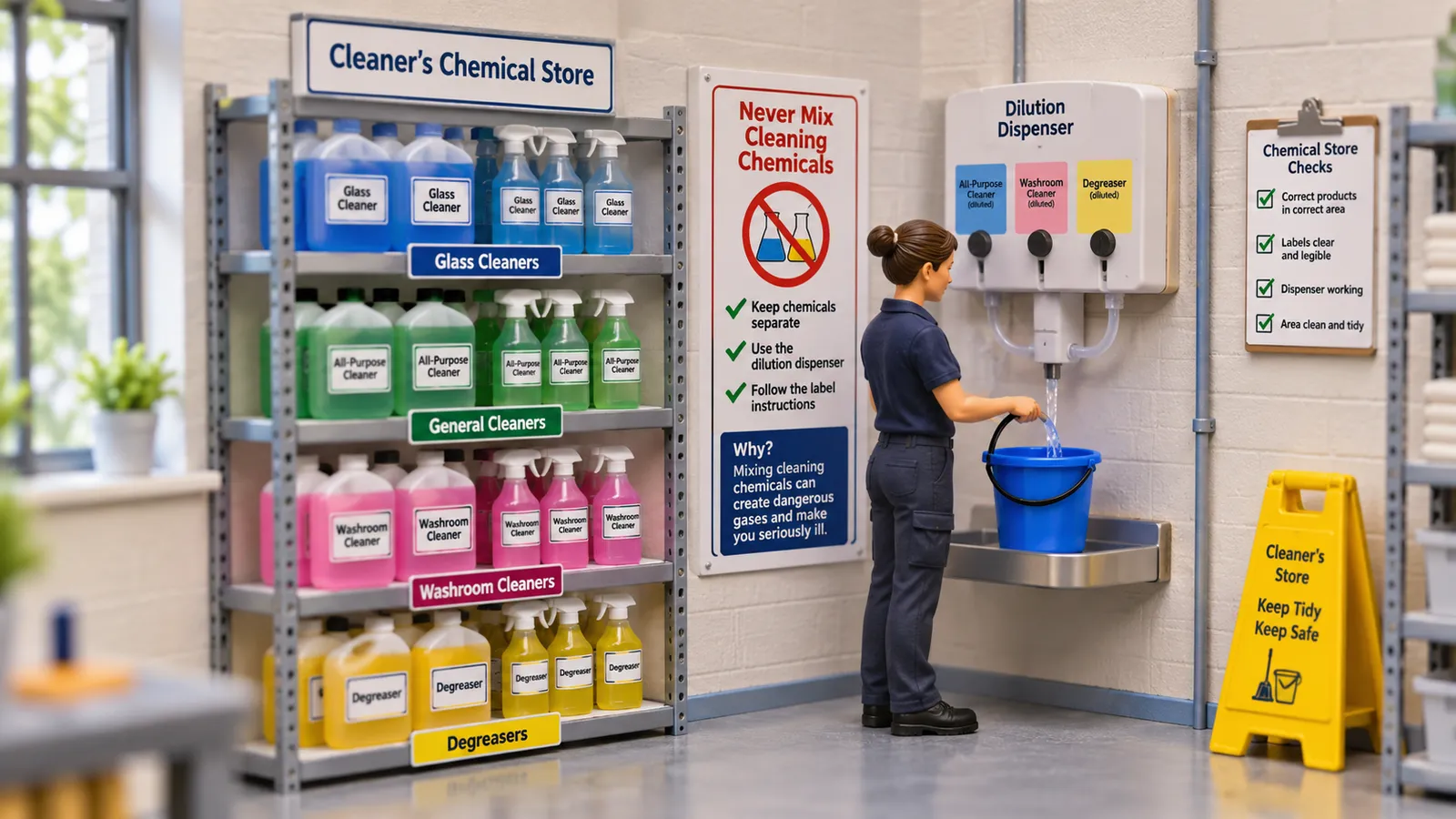
Short answer: Some cleaning products react badly with each other. The best-known example is bleach with an acid cleaner, such as many toilet and bathroom cleaners, which can give off a toxic gas that harms your eyes, throat and lungs. The rule is simple: never mix products. Use one product at a time, diluted exactly as its label says, and keep bleach stored apart from acids.
Watch: Never Mix, about 90 seconds. See the episode →
The video didn’t load. Please refresh the page and try again.
Also: Label the Decant →
“It just needs to be stronger”
Amara cleans offices and bathrooms for a facilities company in Parramatta. Yesterday the bathroom cleaner didn’t shift the stains in one of the bathrooms. So today, in the cleaners’ store, she’s about to add a splash of bleach to her bucket to make it stronger.
It’s a common thought, and it comes from a good place: Amara wants to do the job properly. But stronger isn’t better when two chemicals react. In a small store or a bathroom with the door shut, a gas can build up quickly.
What actually happens
- Bleach plus acid (many toilet, bathroom and descaling cleaners) can release chlorine gas.
- Bleach plus ammonia (some glass and multi-purpose cleaners) can release other toxic gases.
- Bleach plus other cleaners can react in ways that aren’t obvious from the bottle.
Symptoms can include stinging eyes, coughing, a burning throat and trouble breathing. Gloves and safety glasses don’t protect your lungs.
The good news: the warning is usually right there on the bottle. Many bleach labels say that contact with acids releases a toxic gas.
Why it goes wrong on real sites
- “Stronger is better.” Mixing feels like a way to get a tough job done.
- Topping up. Adding a new product to a bucket that still has the old one in it.
- Unlabelled spray bottles. If you don’t know what’s in a bottle, you can’t know what it reacts with. (See Label the Decant.)
- Shared stores. Bleach and acid cleaners on the same shelf, or the same trolley, make mixing easy.
The safer way
This is the routine shown in Never Mix.
- Use one product. Pick the right product for the job and use only that.
- Dilute it exactly as the label says. A wall dispenser takes the guesswork out.
- Start with an empty, clean bucket or bottle. Never top up a mix of something else.
- Keep bleach on its own shelf, away from acid cleaners.
- If it isn’t working, ask your supervisor. There may be a better product for the job, or the surface may need a different method.
- If you’ve already mixed something, leave the area, get fresh air, keep others out, and tell your supervisor. Follow the first aid section of the safety data sheet.
Setting up the store so nobody’s tempted
- Separate shelves for bleach and acid products, clearly signed.
- Wall dispensers for the products used most, so dilution is automatic.
- Fewer products overall: a smaller range is easier to train and harder to mix up.
- A printed label on every bottle you fill (see Label the Decant).
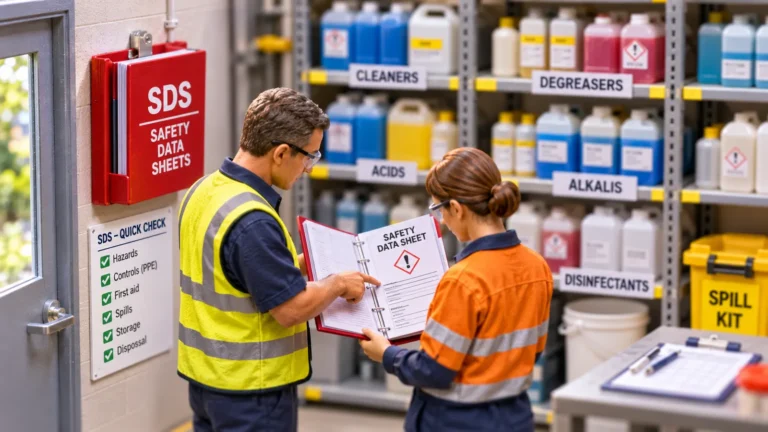
- The safety data sheets kept where cleaners can get to them.
What the law says, in plain English
A business that uses hazardous chemicals has to manage the risks, as far as it reasonably can. That includes storing chemicals that react with each other apart, keeping them labelled, having the safety data sheets on hand, and training workers in how to use them safely. Workers have to take reasonable care and follow those instructions. Victoria has its own law with very similar expectations.
Toolbox talk: three questions for your crew
- Which cleaning products do we use, and are any stored or carried together that shouldn’t be?
- What do you do if a product isn’t doing the job?
- What would you do if you smelt something strong after mixing two products by mistake?
Common questions
Is it safe to mix two products from the same brand?
Not unless the label says so. Brand doesn’t tell you whether two chemicals react.
Can I use bleach and another cleaner one after the other?
Rinse the surface well with water in between, and make sure the area is well ventilated. Better still, choose one product that does the job.
What if the label doesn’t say anything about mixing?
Don’t mix it. Check the safety data sheet, or ask your supervisor.
Who should I call if someone breathes in fumes?
Call 000 in an emergency. For advice, call the Poisons Information Centre on 13 11 26.
Sources
- Safe Work Australia, Model Code of Practice: Managing risks of hazardous chemicals in the workplace
- Safe Work Australia, Model Code of Practice: Labelling of workplace hazardous chemicals
- Safe Work Australia, model WHS Regulations, Chapter 7 (hazardous chemicals), including the regulations on storing incompatible chemicals and on safety data sheets
- Poisons Information Centre, 13 11 26
- WorkSafe Victoria, Occupational Health and Safety Act 2004