People safety · Plant, vehicles and machinery
Missing Guard
No guard, no go. Tag it out and report it.
The video didn’t load. Please refresh the page and try again.
Read the guide: Lockout and isolation →
Suits: Manufacturing · Construction · Warehouse and logistics
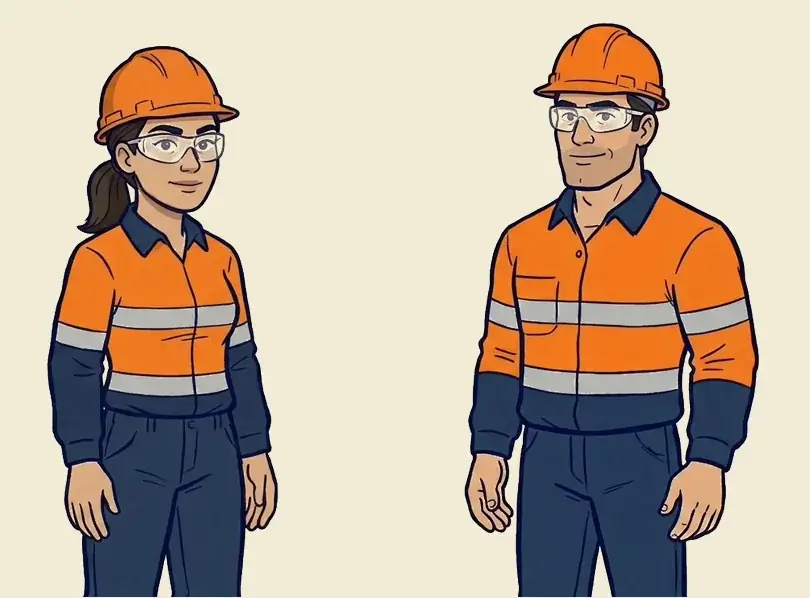
Meet the warehouse crew in this episode →


What happens in this episode
Kath walks up to the bench grinder for a quick job. The guard and eye shield are missing from one wheel, and she’s about to switch it on anyway.
The video freezes on the hazard, named the way the code of practice does: missing guard, moving parts. It asks: how should this be done safely?
Then we see the SafeLee way: Kath doesn’t use it. She switches the grinder off at the isolator, locks the isolator and tags it out of service, then reports it to her supervisor. Nobody uses it until it’s been repaired and cleared.
Why it matters
- About one in seven serious workplace injury claims in Australia is for a wound, cut or amputation, in Safe Work Australia’s latest national figures.
- Guards stop you touching moving parts and stop broken pieces flying out. Using a machine with a guard missing can cause deep cuts, crushed fingers and amputations.
- A tag warns people, but only a lock stops the machine being switched back on.
Source: Safe Work Australia, Key Work Health and Safety Statistics Australia 2026.
Key points
- Guard missing? Nobody uses it.
- Switch it off, then lock and tag it.
- Report it straight away.
- No guard, no go. Tag it out and report it.
Pairs well with Damaged Lead, which also teaches tag it out and report it.
In your version
- Your business’s logo on the opening card and throughout, instead of “Your Business Here”.
- A short quiz after the video. Workers need every answer right for it to count, with as many tries as they need.
- A one-page safe work guide to download, with links to your state’s regulator.
- A record of who watched, when, and how they went, in SafeLee’s built-in training records or your own LMS.
Use it at a toolbox talk
- Play the video (under two minutes).
- At the freeze, ask the crew what should happen, before the video shows them.
- Ask: “Which machines here have guards that get taken off, and how would we know?” Check there are locks and out-of-service tags on hand, and that everyone knows where they are.
More ideas: toolbox talk topics.
Related guides
Check the rules where you work
Safety laws are similar across Australia, but each state and territory has its own regulator, and Victoria has its own Act. Choose where you work for your regulator’s guidance.
WorkSafe Queensland Queensland
Work Health and Safety Act 2011 (Qld)
SafeWork NSW New South Wales
Work Health and Safety Act 2011 (NSW)
WorkSafe Victoria Victoria
Occupational Health and Safety Act 2004 (Vic): a different law with similar duties. Victoria uses compliance codes rather than the model codes of practice.
SafeWork SA South Australia
Work Health and Safety Act 2012 (SA)
WorkSafe WA Western Australia
Work Health and Safety Act 2020 (WA)
WorkSafe Tasmania Tasmania
Work Health and Safety Act 2012 (Tas)
WorkSafe ACT Australian Capital Territory
Work Health and Safety Act 2011 (ACT)
NT WorkSafe Northern Territory
Work Health and Safety (National Uniform Legislation) Act 2011 (NT)
Comcare Commonwealth
Work Health and Safety Act 2011 (Cth)
Model WHS laws and model codes of practice. A national policy body, not a regulator.
General information only, not legal advice. Safety laws differ between states and territories and change over time. Check the law that applies where you work, follow your site procedures, and talk to your regulator or a WHS professional about your workplace. SafeLee episodes and guides support, and don’t replace, workplace-specific training, supervision and risk assessment.
Sources
- Safe Work Australia, Key Work Health and Safety Statistics Australia 2026 (nature of injury)
- Safe Work Australia, Model Code of Practice: Managing the risks of plant in the workplace
- Safe Work Australia, Model Code of Practice: Managing electrical risks in the workplace
This episode is awareness training mapped to the codes of practice, and it names the hazard the way the code of practice does. This awareness training supports, and does not replace, your employer’s risk management process and task-specific training. Model Codes of Practice have legal effect only where adopted in your jurisdiction. Check with your regulator and follow your site procedures.
This video, with your logo.
Every SafeLee episode comes branded for your business, with a quiz, a safe work guide and training records.