People safety · Manual handling
The High Shelf
Keep what you use most within easy reach, and use the right gear for anything stored up high.
The video didn’t load. Please refresh the page and try again.
Read the guide: Toolbox talk topics →
Suits: Retail · Warehouse and logistics · Office and remote work · Healthcare and aged care
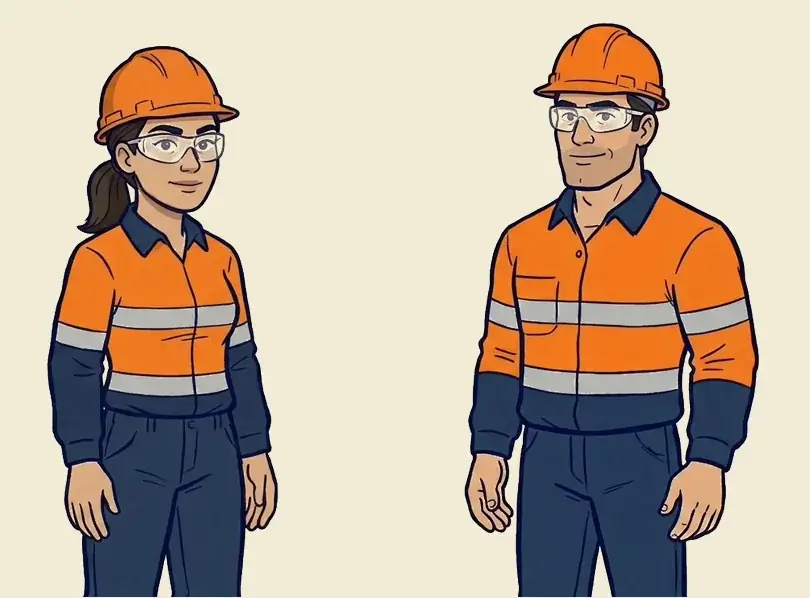
Meet the warehouse crew in this episode →


What happens in this episode
Lee grabs the same tote off the top shelf about twenty times a shift. Each time he reaches up on his toes, arms overhead and back arched. One reach doesn’t look like much, but shift after shift it adds up.
The video freezes and asks: how should this be done safely?
Then we see the SafeLee way: Lea brings over a mobile step platform with handrails and locks all four castors. Lee climbs up, rests the tote on the platform’s tray, climbs down facing the platform with both hands on the rails, and the totes he uses most go on the middle shelf, between waist and shoulder height.
Why it matters
- Body stressing, the strain from lifting, reaching, pushing and carrying, is the most common cause of serious workers’ compensation claims in Australia: 51,800 claims, or 35.2%, in Safe Work Australia’s latest national figures.
- Those claims cost a median of 9.5 weeks off work each.
- Falls from a height caused 28 worker deaths in 2025, 13% of all work-related deaths, which is why the platform, the locked castors and both hands on the rails matter.
Source: Safe Work Australia, Key Work Health and Safety Statistics Australia 2026.
Key points
- Store what you use most between waist and shoulder height.
- Use a step platform with handrails, never your tiptoes or the shelving.
- If there’s still a risk of strain, speak up and reassess the task.
In your version
- Your business’s logo on the opening card and throughout, instead of “Your Business Here”.
- A short quiz after the video. Workers need every answer right for it to count, with as many tries as they need.
- A one-page safe work guide to download, with links to your state’s regulator.
- A record of who watched, when, and how they went, in SafeLee’s built-in training records or your own LMS.
Use it at a toolbox talk
- Play the video (under two minutes).
- At the freeze, ask the crew what should happen, before the video shows them.
- Ask: “Where do we store things up high that we use all the time?” Agree one thing to move, and who’ll move it.
More ideas: toolbox talk topics.
Related guides
Check the rules where you work
Safety laws are similar across Australia, but each state and territory has its own regulator, and Victoria has its own Act. Choose where you work for your regulator’s guidance.
WorkSafe Queensland Queensland
Work Health and Safety Act 2011 (Qld)
SafeWork NSW New South Wales
Work Health and Safety Act 2011 (NSW)
WorkSafe Victoria Victoria
Occupational Health and Safety Act 2004 (Vic): a different law with similar duties. Victoria uses compliance codes rather than the model codes of practice.
SafeWork SA South Australia
Work Health and Safety Act 2012 (SA)
WorkSafe WA Western Australia
Work Health and Safety Act 2020 (WA)
WorkSafe Tasmania Tasmania
Work Health and Safety Act 2012 (Tas)
WorkSafe ACT Australian Capital Territory
Work Health and Safety Act 2011 (ACT)
NT WorkSafe Northern Territory
Work Health and Safety (National Uniform Legislation) Act 2011 (NT)
Comcare Commonwealth
Work Health and Safety Act 2011 (Cth)
Model WHS laws and model codes of practice. A national policy body, not a regulator.
General information only, not legal advice. Safety laws differ between states and territories and change over time. Check the law that applies where you work, follow your site procedures, and talk to your regulator or a WHS professional about your workplace. SafeLee episodes and guides support, and don’t replace, workplace-specific training, supervision and risk assessment.
Sources
- Safe Work Australia, Key Work Health and Safety Statistics Australia 2026 (body stressing, p. 15; fatalities by mechanism)
- Safe Work Australia, Model Code of Practice: Hazardous manual tasks
- Safe Work Australia, Model Code of Practice: Managing the risk of falls at workplaces
Model Codes of Practice have legal effect only where adopted in your jurisdiction. Check with your regulator and follow your site procedures.
This video, with your logo.
Every SafeLee episode comes branded for your business, with a quiz, a safe work guide and training records.