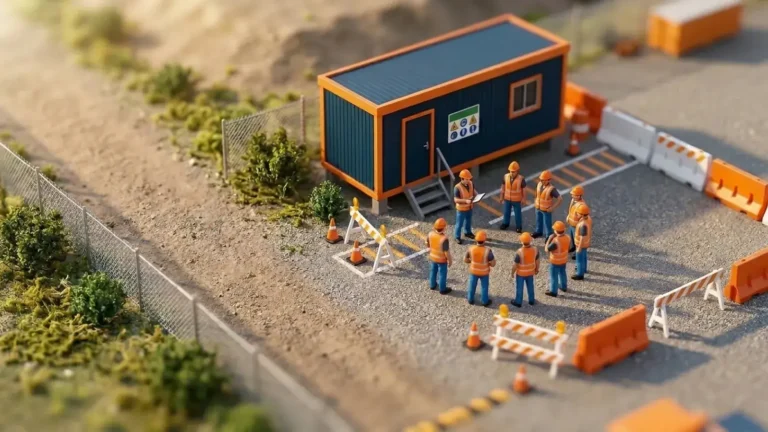

Short answer: A good safety induction gives a new worker what they need to get through their first day and week safely: where the exits and first aid are, how to report a problem, the hazards in their job and the safe way to do it, and who to ask. Then it checks they understood, and records that it happened.
Watch: Blind Corner, about 90 seconds. See the episode →
The video didn’t load. Please refresh the page and try again.
Also: The Mystery Bottle →
Why the first week matters
Tom starts as a storeperson at a cold-storage warehouse in Townsville on a Monday. He’s keen, he wants to impress, and he doesn’t know what he doesn’t know. He hasn’t driven a pallet jack in a freezer before. He doesn’t know the forklifts come round the blind corner by the dock doors. He doesn’t know that the floor near the blast freezer ices up.
New workers are often at the greatest risk in their first weeks on a job, precisely because everything is unfamiliar. An induction isn’t a welcome speech. It’s how you make sure Tom goes home on Friday in one piece.
Before day one
Some of the induction can happen before the worker arrives, so day one is about the site, not the paperwork.
- Send the basics ahead: start time, where to park, who to ask for, what to wear and bring (boots, long pants, sunscreen).
- Check licences and tickets they’ll need, such as a forklift licence or a construction white card, and get copies.
- An online induction can cover company rules, policies and general safety before they arrive. Keep it short; nobody remembers 45 minutes of slides.
- Line up a buddy: an experienced worker who’ll show them the ropes for the first week.
What online inductions can’t do: show Tom where the icy patch is. Online is great for the general stuff, but the site walk and the job itself have to happen in person.
The first hour: the “how not to get hurt today” basics
Before Tom touches a pallet jack, walk him around and cover:
- Emergencies: exits, the assembly point, what the alarm sounds like, who the first aiders and wardens are.
- First aid: where the kit and the eyewash station are, and how to get help.
- Getting around safely: pedestrian walkways, forklift zones, crossing points, areas he’s not allowed in.
- Amenities: toilets, lunch room, drinking water.
- Reporting: how to report a hazard, an injury or a near miss, and that it’s expected, not “dobbing”.
- Stop work: that he can stop and ask if something doesn’t look safe, without getting in trouble.
The job itself: where most inductions fall short
This is the bit many inductions skip. The site tour is done, the forms are signed, and the new worker is sent off to “follow Steve”.
For Tom’s job, that means:
- The tasks he’ll actually do, and the hazards in each: picking heavy cartons, the cold, the pallet jack, the icy floor.
- The safe way to do each task, shown, not just described. Let him watch it done properly, then do it while someone watches.
- PPE: what to wear for each task, where to get it, how to check it fits. For Tom: freezer gear, gloves, safety boots.
- Equipment: what he’s allowed to use now, what he needs training or a licence for first, and how to check it before use.
- His supervisor and the health and safety representative, if there is one, and how to raise a concern.
A quick test: if your induction would be the same for the new receptionist as for the new forklift driver, it’s not covering the job.
Check it stuck
Signing a form doesn’t mean Tom understood. Before he works on his own:
- ask him a few questions (“What do you do if you see ice on the floor near the blast freezer?”)
- have him show you the safe way to do his main tasks
- if English isn’t his first language, use visuals and simple words, and ask him to explain it back
Short videos help here: a two-minute clip showing the mistake and the safer way sticks far better than a page of rules, and a quick quiz confirms it landed. See how SafeLee works.
Record it and follow up
Keep a record of: what was covered, who ran it, the date, and how understanding was checked. Then follow up:
- End of week one: a five-minute chat. What’s been hard? Anything unsafe he’s noticed?
- End of month one: any further training he needs before he takes on more tasks?
If you don’t have an LMS, SafeLee’s training records keep this for you, with a personal link on the worker’s phone and a record of each step.
Labour hire, contractors and visitors
- Labour-hire workers: both the labour-hire business and your business have safety duties for the same worker. Agree up front who covers what. Usually the labour-hire business covers general safety, and your site covers the site and the job.
- Contractors: a shorter site induction (emergencies, site rules, hazards in their work area, who to report to), plus checking their own safety documents for the work.
- Visitors: sign-in, a quick briefing on emergencies and where they can’t go, and an escort where needed.
- Construction: anyone doing construction work also needs general construction induction training (the white card) before they start. That’s on top of your site induction, not instead of it.
- Farms: every new person gets an induction, including family members and seasonal workers. The farm safety guide covers what a farm induction includes.
What the law says, in plain English
Australia’s WHS laws expect a business to give workers the information, training, instruction and supervision they need to work safely, suited to the job and the risks, and in a way they can understand. For a new worker, that’s what a good induction does. When more than one business is involved, as with labour hire, they share the duty and have to agree who does what. Victoria has its own law with very similar expectations.
Your safety induction checklist
Before day one
- Start details, PPE and what to bring sent
- Licences and tickets checked and copied
- Online induction completed (if used)
- Buddy arranged
First hour
- Emergency exits, alarm, assembly point, wardens
- First aid and first aiders
- Walkways, vehicle zones, no-go areas
- Amenities
- How to report hazards, injuries and near misses
- Right to stop and ask
The job
- Each main task: hazards and the safe method, shown and practised
- PPE issued and fitted
- Equipment: what’s allowed now, what needs training or a licence
- Supervisor and HSR introduced
Check and record
- Understanding checked (questions and demonstration)
- Induction recorded: what, who, when, how checked
- Week-one and month-one follow-ups booked
Common questions
How long should a safety induction take?
As long as it takes to cover the basics and the job properly. For many workplaces that’s an hour or two on day one, plus supervised time on the job over the first week.
Is an online induction enough?
Not on its own. It’s good for policies and general safety, but the site walk-through and the job-specific training need to happen in person.
Do casuals and labour-hire workers need an induction?
Yes. Every worker needs the information and training to do their job safely, however they’re employed.
Do we have to repeat inductions?
Refresh them when the job, equipment or site changes, and when someone returns after a long break. Many businesses also do a short annual refresher.
Sources
- Safe Work Australia, model WHS Act: s19 (primary duty of care, including information, training, instruction and supervision), s46 (consulting other duty holders)
- Safe Work Australia, model WHS Regulations: r39 (information, training and instruction); Part 6.5 (general construction induction training)
- Safe Work Australia, Labour hire: duties of persons conducting a business or undertaking guidance
- WorkSafe Victoria, Occupational Health and Safety Act 2004