People safety · Plant, vehicles and machinery
The Crush Zone
Stay clear of the gap between a moving load and a fixed object.
The video didn’t load. Please refresh the page and try again.
Read the guide: WHS due diligence →
Suits: Manufacturing · Construction
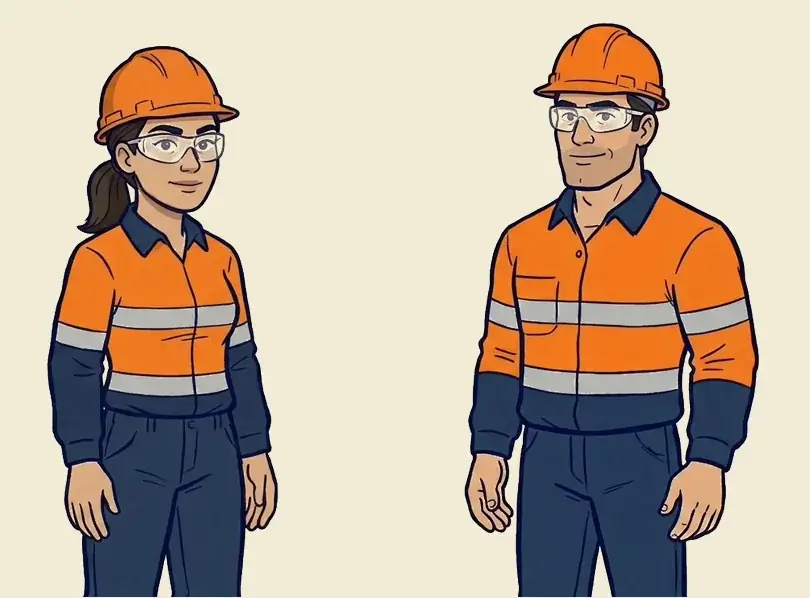
Meet the warehouse crew in this episode →


What happens in this episode
Jarrah is pulling a loaded pallet jack into a bay, walking backwards towards a steel column. The gap behind him gets smaller with every step, until Sione raises a hand.
The video freezes on the hazard, named the way the code of practice does: crushing and trapping. It asks: how should this be done safely?
Then we see the SafeLee way: Jarrah lets go of the handle and steps out of the gap. He turns the jack round, pushes the load into the bay ahead of him from the open side, facing where it’s going, and stops it short of the column.
Why it matters
- Being trapped between moving and stationary objects caused one in twenty worker deaths in Australia in 2025, in Safe Work Australia’s latest national figures.
- When a load moves towards a wall, column, rack or bench, the space between them gets smaller. Anyone in that gap can be crushed.
- Pushing keeps the load ahead of you and lets you see where it’s going, so you never end up between the load and a fixed object.
Source: Safe Work Australia, Key Work Health and Safety Statistics Australia 2026.
Key points
- Spot the gap before you move the load.
- Push the load in, ahead of you.
- Stop short of the fixed object.
- Stay clear of the gap between a moving load and a fixed object.
In your version
- Your business’s logo on the opening card and throughout, instead of “Your Business Here”.
- A short quiz after the video. Workers need every answer right for it to count, with as many tries as they need.
- A one-page safe work guide to download, with links to your state’s regulator.
- A record of who watched, when, and how they went, in SafeLee’s built-in training records or your own LMS.
Use it at a toolbox talk
- Play the video (under two minutes).
- At the freeze, ask the crew what should happen, before the video shows them.
- Ask: “Where on our site does a load move towards a wall, column or rack with someone beside it?” Agree one change, such as a marked set-down area or a push-in rule.
More ideas: toolbox talk topics.
Related guides
Check the rules where you work
Safety laws are similar across Australia, but each state and territory has its own regulator, and Victoria has its own Act. Choose where you work for your regulator’s guidance.
WorkSafe Queensland Queensland
Work Health and Safety Act 2011 (Qld)
SafeWork NSW New South Wales
Work Health and Safety Act 2011 (NSW)
WorkSafe Victoria Victoria
Occupational Health and Safety Act 2004 (Vic): a different law with similar duties. Victoria uses compliance codes rather than the model codes of practice.
SafeWork SA South Australia
Work Health and Safety Act 2012 (SA)
WorkSafe WA Western Australia
Work Health and Safety Act 2020 (WA)
WorkSafe Tasmania Tasmania
Work Health and Safety Act 2012 (Tas)
WorkSafe ACT Australian Capital Territory
Work Health and Safety Act 2011 (ACT)
NT WorkSafe Northern Territory
Work Health and Safety (National Uniform Legislation) Act 2011 (NT)
Comcare Commonwealth
Work Health and Safety Act 2011 (Cth)
Model WHS laws and model codes of practice. A national policy body, not a regulator.
General information only, not legal advice. Safety laws differ between states and territories and change over time. Check the law that applies where you work, follow your site procedures, and talk to your regulator or a WHS professional about your workplace. SafeLee episodes and guides support, and don’t replace, workplace-specific training, supervision and risk assessment.
Sources
- Safe Work Australia, Key Work Health and Safety Statistics Australia 2026 (fatalities by mechanism)
- Safe Work Australia, Model Code of Practice: Managing the risks of plant in the workplace
- Safe Work Australia, Model Code of Practice: Hazardous manual tasks
This episode is awareness training mapped to the codes of practice, and it names the hazard the way the code of practice does. This awareness training supports, and does not replace, your employer’s risk management process and task-specific training. Model Codes of Practice have legal effect only where adopted in your jurisdiction. Check with your regulator and follow your site procedures.
This video, with your logo.
Every SafeLee episode comes branded for your business, with a quiz, a safe work guide and training records.