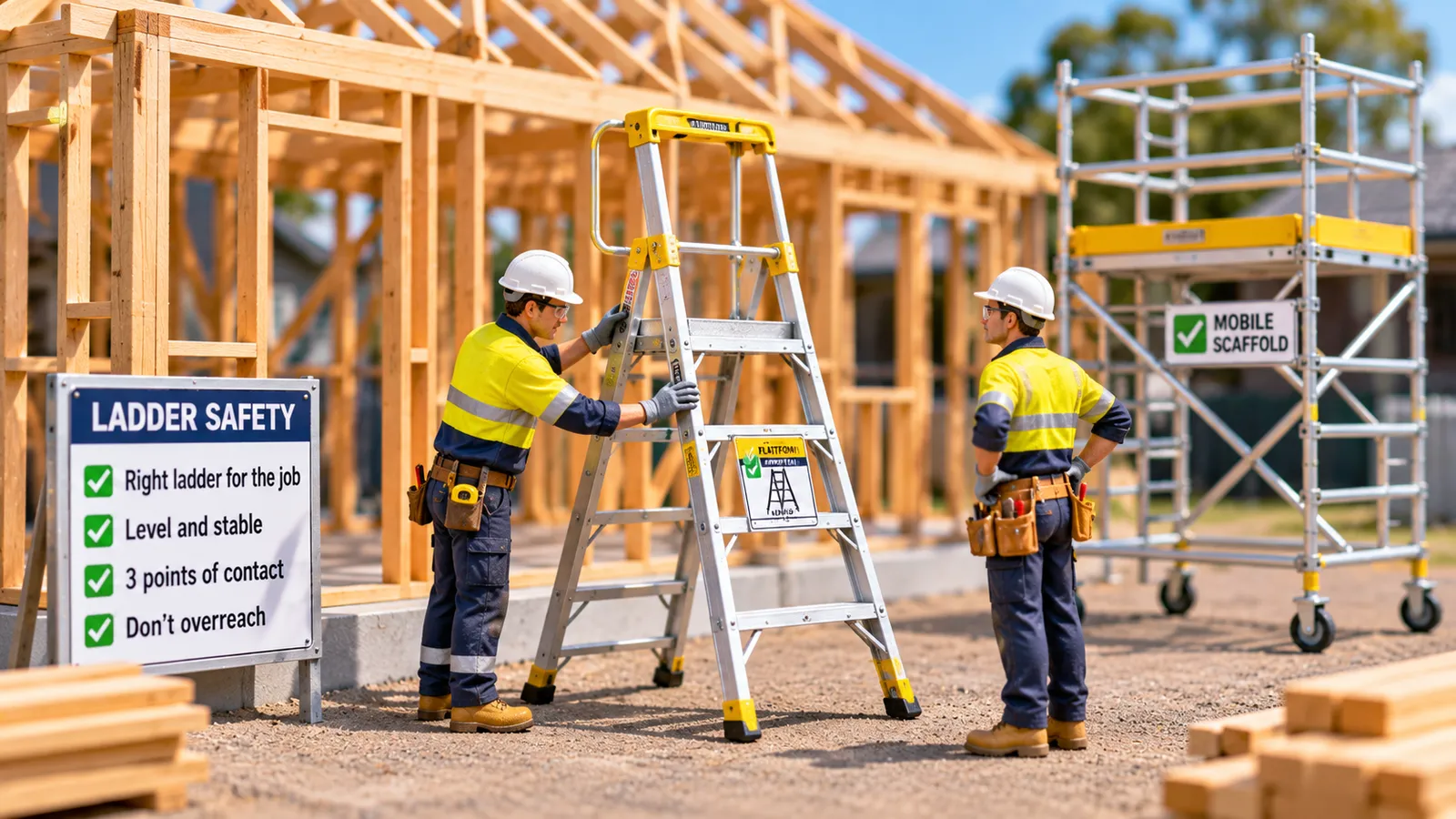
Short answer: Ladders are for short, light jobs where nothing safer is practicable. Before climbing, check the ladder is the right type and in good condition, set it up on firm, level ground, and keep three points of contact. Don’t carry heavy loads, don’t overreach, and don’t stand on the top rungs. For longer or heavier work, a platform ladder, mobile scaffold or elevated work platform is usually safer.
Watch: The High Shelf, about 90 seconds. See the episode →
The video didn’t load. Please refresh the page and try again.
Also: The Loading Step →
“I’ll just be a minute up there”
Tama is a carpenter on a two-storey house build on the Sunshine Coast. He needs to fix one last piece of flashing near the eaves. The scaffold’s been moved to the other side, so he grabs the step ladder from the ute, sets it on the sloping dirt and climbs to the second-top step to reach.
It’s a two-minute job. That’s why it feels safe, and why so many ladder falls happen on short jobs.
Why it matters
Falls, trips and slips are one of the biggest causes of serious injury at work in Australia: about one in five serious workers’ compensation claims (22.2% in Safe Work Australia’s latest national figures). A fall from even a low height can cause a serious head or spine injury.
Is a ladder the right tool?
Ask these first:
- Can the job be done from the ground? Long-handled tools, or bringing the item down.
- Is there a safer way up? A mobile scaffold, a platform ladder with handrails, or an elevated work platform for longer jobs.
- How long will it take? Ladders suit short, light tasks, not hours of work.
- Do I need both hands? If so, a platform with handrails is safer than a ladder.
Before every climb: the quick checks
- Right ladder: an industrial-rated ladder of the right type and height. Household ladders aren’t built for work use.
- Good condition: no bent, cracked or missing rungs; feet and locks working; no oil or mud on the steps.
- Firm, level ground: not on boxes, bricks, slopes, or soft dirt. Use levelling devices made for the ladder, not packers.
- Step ladders fully open and locked.
- Extension ladders at the right angle (about 1 out for every 4 up), secured at the top or footed, and extending about a metre above the landing.
- Clear around the base: no traffic or doors swinging into it.
While you’re up there
- Three points of contact: two feet and a hand, or two hands and a foot.
- Don’t overreach. Keep your belt buckle between the rails. Climb down and move the ladder.
- Don’t stand on the top two steps of a step ladder, or the top three rungs of an extension ladder.
- Carry light tools only, on a belt. Pass heavier things up separately.
- Face the ladder when climbing up or down.
Never use instead of a ladder
Chairs, boxes, bins, pallets, shelving or a forklift’s tynes. In The High Shelf, Lee reaches overhead on his toes for a tote he grabs all shift. The fix is to move what you use most to between waist and shoulder height, and use a step platform with handrails for anything stored up high.
What the law says, in plain English
A business has to manage the risk of falls. The best option is to do the work on the ground or on a solid surface. If that’s not possible, it should use a fall-prevention device, such as scaffolding or a platform with guardrails, before relying on ladders. Ladders should be suitable for the task and set up and used safely. Construction work involving a risk of a fall of more than 2 metres is high-risk construction work, which needs a safe work method statement (SWMS). Victoria has its own law with similar expectations.
Toolbox talk: three questions for your crew
- Which jobs do we use ladders for that could be done another way?
- When did we last check our ladders? Which ones should be tagged out?
- Where on site is the ground bad for setting up a ladder?
Common questions
Are step ladders allowed on building sites?
Yes, for suitable short tasks, if they’re industrial-rated and used properly. Many builders now prefer platform ladders with handrails.
How often should ladders be checked?
Before each use by the person using it, plus regular documented inspections. Tag out and remove damaged ladders.
Is there a height limit for working from a ladder?
The rules focus on the risk, not a single height. Look for a safer option for anything long, heavy or high, and follow your site’s rules and the SWMS.
Sources
- Safe Work Australia, Key Work Health and Safety Statistics Australia 2026 (falls, trips and slips: 22.2% of serious claims, preliminary 2024–25)
- Safe Work Australia, Model Code of Practice: Managing the risk of falls at workplaces
- Safe Work Australia, Model Code of Practice: Managing the risk of falls in housing construction
- Safe Work Australia, model WHS Regulations, Part 4.4 (falls), regulations 78 to 80; regulation 291 (high-risk construction work)
- WorkSafe Victoria, Occupational Health and Safety Regulations 2017, prevention of falls