
Short answer: There’s no single list of mandatory WHS courses for every business. Instead, the law expects you to give each worker the training they need for their job and its risks, in a way they understand, plus any licences the law requires for specific work, training for people with safety roles, and refreshers when things change. Then keep records that show it was done and understood.
Watch: The Mystery Bottle, about 90 seconds. See the episode →
The video didn’t load. Please refresh the page and try again.
Also: Chemical Spill →
“What training do I legally have to give?”
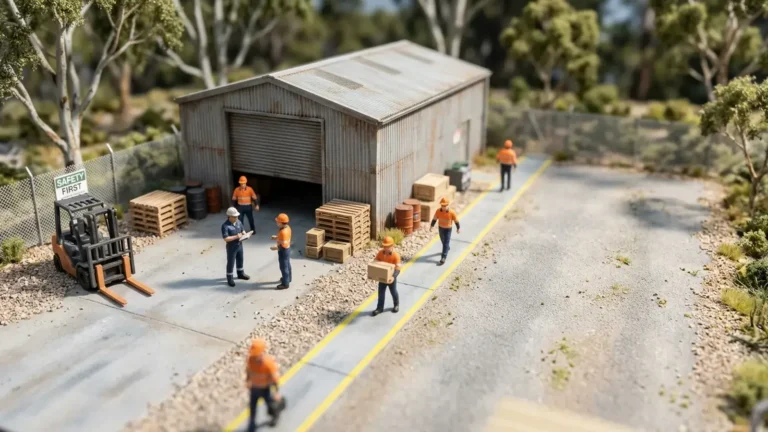
Nick runs a landscaping and grounds maintenance business in Cairns: 12 staff plus casuals in the wet season. A big council contract asks him to “provide evidence of WHS training for all workers”. Nick’s first question is the one most small businesses ask: which courses are compulsory?
The honest answer: it depends on the work. The law doesn’t hand Nick a list. It expects him to look at what his crew actually does, and train for that.
The five kinds of WHS training most businesses need
1. Induction, for everyone. Before anyone starts work: emergencies, first aid, reporting, site rules, and the hazards in their job. See our safety induction checklist.
2. Task-specific training, for the risky jobs. For Nick’s crew: ride-on mowers and slopes, brushcutters and eye protection, hedge trimmers, chemicals for weed spraying, working in heat, traffic near roads, and manual handling of mulch bags and equipment.
3. Licences and tickets the law requires. Some work needs a licence by law, regardless of experience: for example, forklifts and other high risk work, and the general construction induction (white card) for construction work. Chemical spraying may need specific accreditation depending on the state. Check your state’s rules: your regulator is listed under “Check the rules where you work” below.
4. Training for people with safety roles.
- Supervisors: how to supervise safely, spot problems and run toolbox talks.
- First aiders and fire wardens: accredited courses with set refresh periods.
- Health and safety representatives (HSRs): if workers elect an HSR, the business must let them attend approved HSR training if they ask, and pay for it.
5. Refreshers and change training. When equipment, tasks, chemicals or the site change; after incidents and near misses; when someone comes back after a long break; and at sensible regular intervals.
“Suitable and understandable”: the part people miss
Training only counts if it works for the people receiving it. Nick has three backpackers from overseas, one older worker who doesn’t read much, and a school-leaver apprentice. A 20-page procedure won’t land with any of them.
What works:
- short, visual training that shows the task
- plain language, and other languages where needed
- a supervisor demonstration and a go at the task
- a quick check that they understood
How to show it was done
When the council asks for evidence, Nick wants to hand over more than a pile of certificates. Good records show:
- who was trained
- on what: the task or topic, and which version
- when, and when it’s due again
- how understanding was checked: quiz result, demonstration, supervisor sign-off
- licences and tickets, with copies and expiry dates
A simple training matrix covers most of this. If you don’t have an LMS, SafeLee’s built-in training records keep it all for you, including quiz answers and refresher reminders.
What the law says, in plain English
Australia’s WHS laws expect a business to provide the information, training, instruction and supervision workers need to work safely, suited to the work and its risks and easy to understand. Some work needs a licence by law. Health and safety representatives are entitled to approved training if they ask. Victoria has its own law with very similar expectations, including training for HSRs.
Nick’s WHS training plan, on one page
| Who | Training | When |
|---|---|---|
| Everyone | Induction (site, emergencies, reporting, their tasks) | Before starting |
| Everyone | Manual handling, heat and sun, chemicals awareness | First week; refresh yearly |
| Mower operators | Ride-on mower and slopes, pre-start checks | Before use; refresh yearly or when equipment changes |
| Spray operators | Chemical handling and any required accreditation | Before spraying; per accreditation |
| Roadside crews | Traffic awareness and site setup | Before roadside work |
| Supervisors | Supervising safely, toolbox talks | Within first month |
| First aiders | Accredited first aid and CPR | Per certificate |
| HSR (if elected) | Approved HSR course | On request |
Common questions
Is there a list of mandatory WHS courses?
Only for specific work that needs a licence or accreditation. Everything else depends on your work and its risks.
Do casuals and labour hire need the same training?
They need the training for the work they’ll do. With labour hire, agree with the labour-hire business who provides what.
How often should WHS training be refreshed?
When things change, after incidents, and at regular intervals that suit the risk. Some certificates and licences set their own renewal periods.
Does online WHS training count?
Yes, if it’s suitable for the work and you check understanding. Pair it with hands-on practice for physical tasks.
Sources
- Safe Work Australia, model WHS Act: s19 (primary duty of care), s72 (training for health and safety representatives)
- Safe Work Australia, model WHS Regulations: r39 (information, training and instruction); Chapter 4 Part 4.5 (high risk work licences); Part 6.5 (general construction induction training)
- WorkSafe Victoria, Occupational Health and Safety Act 2004