Short answer: PCBU stands for “person conducting a business or undertaking”. In everyday terms, it’s the business, whoever is running the work. If you run a business, a council department, a not-for-profit with staff, or you work for yourself, you’re almost certainly a PCBU. And the PCBU has the main job of keeping people safe at work: its own staff, contractors, labour hire, visitors and the public.
Watch: Missing Guard, about 90 seconds. See the episode →
The video didn’t load. Please refresh the page and try again.
A quick example
Mia runs a plumbing business in Toowoomba with four plumbers and an apprentice. She also uses a labour-hire labourer on bigger jobs.
Is Mia’s business a PCBU? Yes. And its safety duty covers:
- the four plumbers and the apprentice
- the labour-hire labourer (even though another company pays him)
- the homeowner whose bathroom is being renovated
- anyone walking past the trench outside
That’s the big idea behind the term. Safety duties don’t depend on who signs the payslip. They depend on who’s running the work and who could be hurt by it.
Why “PCBU” and not just “employer”?
Because a lot of work today isn’t straightforward employment. Think of contractors, labour hire, volunteers, apprentices and work experience students. The law uses “PCBU” so that whoever runs the work is responsible for the people doing it, however they’re engaged.
Who counts as a PCBU?
| This… | PCBU? | Why |
|---|---|---|
| Dave, a sole-trader landscaper | Yes | He runs a business, so he’s responsible for his own safety and anyone his work affects, like a client’s kids in the backyard. |
| A café with eight casual staff | Yes | A business with workers. |
| A local council | Yes | It conducts an undertaking with workers, even though it’s not making a profit. |
| A charity that employs a coordinator and uses volunteers | Yes | It has a paid worker, so it’s a PCBU, and its volunteers are workers too. |
| A community footy club run entirely by volunteers, with no paid staff | Usually no | A volunteer association with no employees isn’t a PCBU. |
| Sam, a forklift driver at a warehouse | No | Sam is a worker. Workers have their own duties, but the warehouse business is the PCBU. |
Rule of thumb: if you’re running the show, making money from it, or directing other people’s work, treat yourself as a PCBU.
What the PCBU actually has to do
The law calls it the “primary duty of care”. In plain English: do what you reasonably can to make sure nobody gets hurt or sick because of the work.
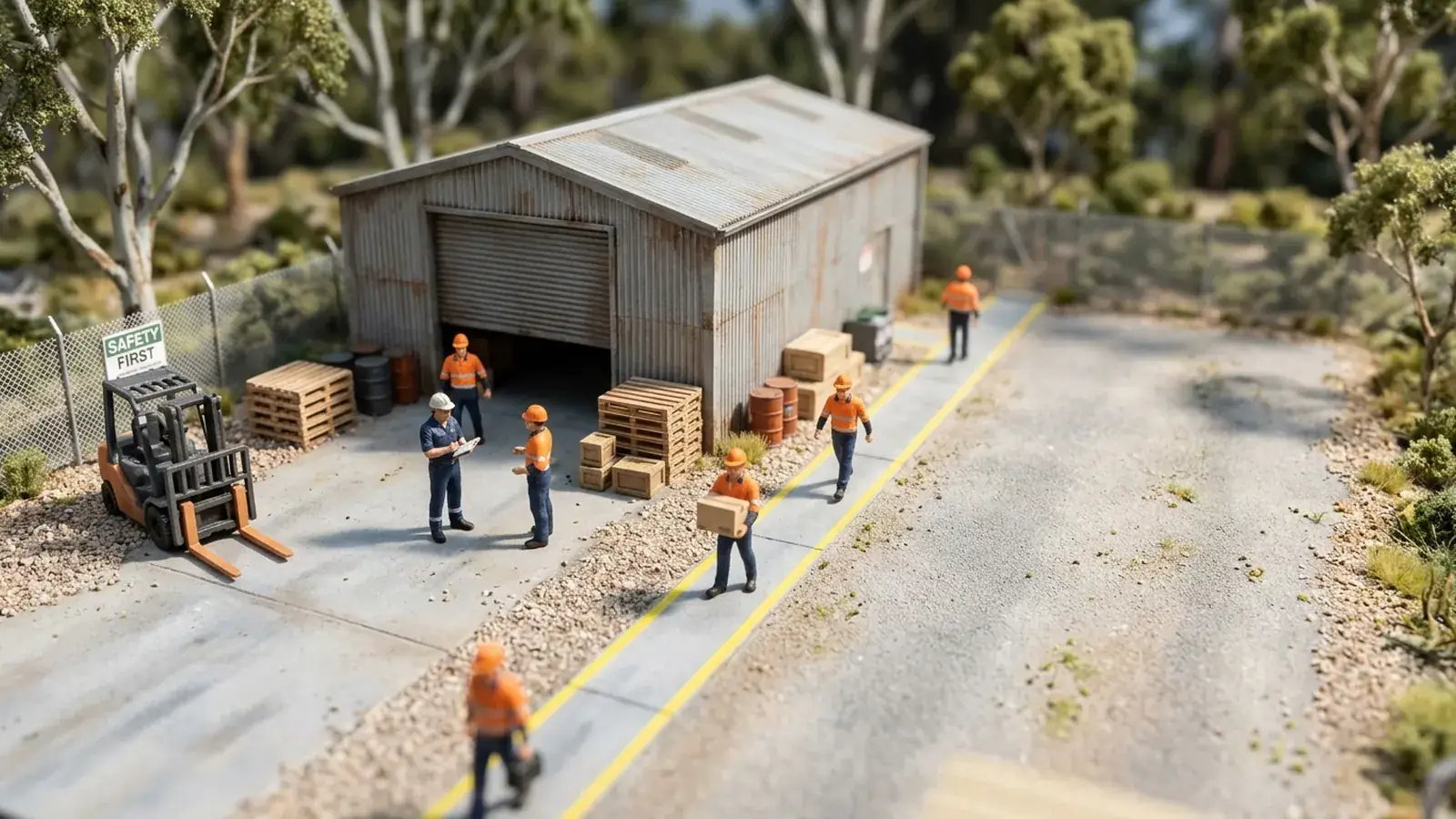
Picture Kev’s warehouse in Ipswich. Here’s what the duty looks like on an ordinary Tuesday:
- A safe place to work. The aisle is clear, the lighting works, and the spilled shrink-wrap isn’t left for someone to slip on.
- Safe equipment. The pallet jack with the dodgy wheel is tagged out, not “just used carefully”.
- Safe ways of working. There’s an agreed way to pick heavy cartons, and forklifts and people are kept apart.
- Somewhere decent to take a break, with clean toilets and drinking water.
- People know what they’re doing. The new casual, Priya, is shown how to do the job safely, someone checks she understood, and she’s supervised until she’s confident.
- Keeping an eye on things. Kev notices that two people have mentioned sore backs from the bottom pallet row, and does something about it.
The duty also covers mental health, not just physical injuries. If Kev’s team is regularly pushed to finish a double load before a 3 pm truck, with no extra help, that pressure is a safety issue too.
“Reasonably practicable”: what you’re expected to do
This phrase scares people, but the idea is simple: do what a sensible business would do, given how serious the risk is and what fixes are available.
Back to Kev’s warehouse. His workers bend to the floor dozens of times a shift to pick cartons from the bottom of pallets. What would a sensible business do?
- Can the bending be removed? A forklift can set the pallet on a waist-height stand, so cartons are picked at a comfortable height. Cheap, quick and it fixes the problem at the source. Kev should do this.
- Could he buy a fancy automated picking system? Possibly, but it’s not needed if the stand fixes the risk.
- Is “tell everyone to lift with their legs” enough on its own? No. Training matters, but it’s not a substitute for fixing the setup when a simple fix exists.
Two things to remember:
- Start with the fix that removes the risk, then work down to less effective options, such as instructions and PPE, only if you can’t.
- Cost only counts if it’s way out of proportion to the risk. “It’s a hassle” or “it costs a bit” isn’t a reason to leave a real risk in place.
When more than one business is involved
On many jobs, several PCBUs are responsible for the same people at the same time.
Take a shopfitting job in a Brisbane shopping centre. There’s the head contractor, an electrical subcontractor, a labour-hire business supplying two labourers, and the shopping centre itself. All four have safety duties, and they overlap.
The law doesn’t let them pass the buck (“that’s the sparky’s problem”). Instead, they have to talk to each other and agree who does what: who runs the induction, who checks licences, who supplies PPE, who supervises the labourers, and who keeps which records. A two-minute conversation at the start of the job prevents a lot of finger-pointing later.
Who else has duties?
The PCBU isn’t the only one with responsibilities:
| Who | What it means in practice |
|---|---|
| The business (PCBU) | Do what you reasonably can to keep everyone safe. |
| Directors and senior managers (“officers”) | Personally make sure the business is doing its job: understand the main risks, provide the money and people to manage them, and check it’s actually happening. See our guide: WHS due diligence for directors. |
| Workers | Take reasonable care of yourself and others, follow reasonable safety instructions, and speak up. |
| Visitors and others | Take reasonable care and follow site rules. |
So when the warehouse director signs off next year’s budget, cutting the replacement pallet stands to save money is a decision with personal responsibility attached.
Where training fits in
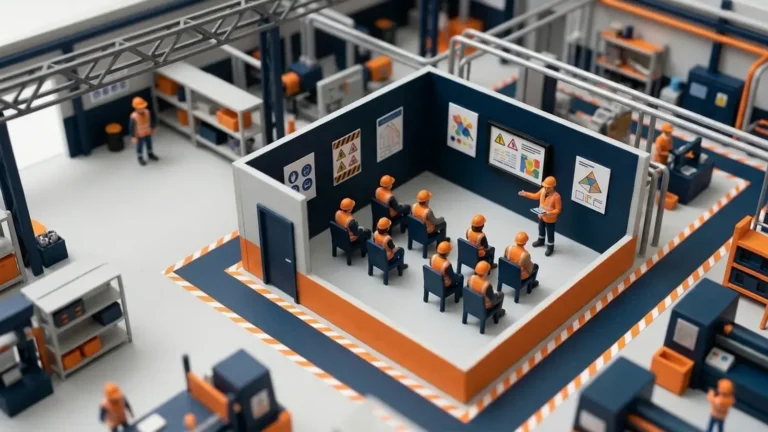
Training is one of the ways a PCBU meets its duty, and it’s where many businesses fall short without realising.
Compare two first days for Priya, the new casual at Kev’s warehouse:
- Version 1: A supervisor says “watch your back and ask if you’re not sure”, and she’s on the floor in ten minutes. Nothing is written down.
- Version 2: Priya watches a short video showing the right way to pick from the pallet stand, the supervisor asks her two quick questions to check she got it, shows her where the trolleys and the first-aid kit are, and records that her induction is done.
If Priya hurts her back in week two, only Version 2 shows the business did what it reasonably could. Good training is:
- about the real tasks and risks in your workplace
- easy to understand, in plain language, with visuals, and in other languages where needed
- checked, so you know people understood it and didn’t just sit through it
- refreshed when jobs, equipment or people change
- recorded: who, what, when, and how understanding was checked
That’s what SafeLee is built for: short episodes on real workplace hazards, quick questions that check understanding, and a record of who completed what, in your LMS or in ours. See how SafeLee works and SafeLee’s training records.
What the law says, in plain English
Under Australia’s model WHS laws, the PCBU must ensure, so far as is reasonably practicable, the health and safety of its workers and anyone else affected by its work. That includes a safe workplace, safe equipment and methods, proper facilities, and the information, training, instruction and supervision people need. Victoria has its own law, which puts these duties on “employers” and “self-employed persons” rather than PCBUs; the ideas are very similar. Western Australia’s law uses PCBU and follows the model closely.
Common questions
I’m a sole trader. Am I a PCBU?
Yes. You’re responsible for your own safety and for anyone your work could affect: clients, the public, and any subcontractors you bring in.
Is a PCBU the same as an employer?
Mostly, but it’s broader. It also covers the businesses that use contractors, labour hire and volunteers.
Can I be personally fined as a manager or director?
Directors and senior managers have their own personal duty to make sure the business is managing safety properly, and workers have duties too. Penalties can be serious, and industrial or workplace manslaughter laws now apply in most parts of Australia.
Can we hand our safety responsibilities to a contractor?
No. You can share the work, but not the responsibility. Each business keeps its own duty and has to coordinate with the others.
Does this cover stress and mental health?
Yes. The duty covers psychological health as well as physical health, including things like workload, bullying and fatigue.
Sources
- Safe Work Australia, model Work Health and Safety Act: s4 (meaning of health), s5 (meaning of PCBU), s14 (duties not transferable), s16 (more than one person can have a duty), s18 (reasonably practicable), s19 (primary duty of care), s27 to s29 (officers, workers, other persons), s46 (duty to consult other duty holders)
- Safe Work Australia, model WHS Regulations: r39 (information, training and instruction); psychosocial hazards provisions
- Safe Work Australia, Interpretive guideline: The meaning of “reasonably practicable”
- Safe Work Australia, Hazardous manual tasks model Code of Practice
- WorkSafe Victoria, Occupational Health and Safety Act 2004
- WorkSafe WA, Work Health and Safety Act 2020